Omakase In Tokyo: How To Book, What It Costs And What To Expect At The Counter
Omakase in Tokyo runs on a booking machine most travellers never see: two month release windows, per seat platform fees, card guarantees and cancellation ladders that can take the full course price. Here is how each part works, and where the walk-in alternatives are.
Short answer
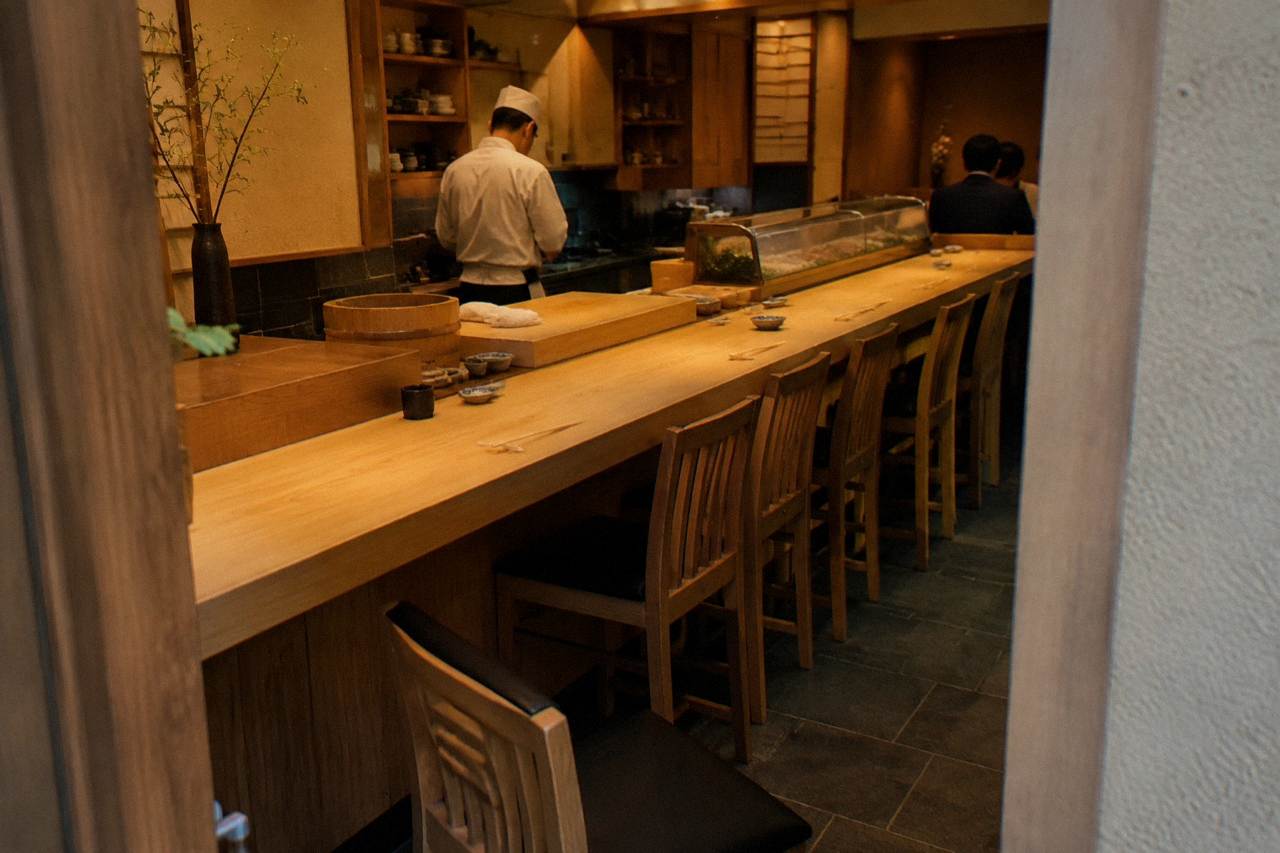
Omakase means the chef decides, and in Tokyo that decision runs from inexpensive counter sets to very expensive tasting menus. Popular counters typically open reservations about two months ahead. Booking platforms charge per seat fees of roughly 390 to 440 yen with a card guarantee, and same day cancellations typically forfeit the full course price. Lunch is usually far cheaper than dinner.
Shinjuku Sushi Hatsume holds a 4.9 rating on Google across 2,487 reviews, sits in the moderate price band and carries a booking recommended label, and that combination is the standard shape of omakase in this city: excellent, mid priced, and not entirely walk-in. The word itself is simpler than the machinery around it. Omakase means the chef decides, and everything else, the release calendars, the per seat fees, the card guarantees, exists because a ten seat counter cannot absorb a no-show the way a hundred seat dining room can.
This guide walks through the whole system in order. It defines omakase, then covers booking windows, the platforms that take reservations for international guests, the cancellation ladder, the price ladder expressed in price levels rather than yen, and finally what to expect once you are sitting at the counter with a wet towel in front of you. Our own guide, The Tokyo Food List, holds the 980+ Tokyo restaurants with reservation difficulty labels and booking links, made to open on a phone and pick by neighbourhood, and it is the fastest way to see which counters near you are walk-in versus booking usually required. If you want to build the rest of your eating days around that one counter splurge, our guide to the Tokyo food stops you should not skip covers everything from morning market lanes to late yakitori runs.
What Is Omakase?
Omakase means "I leave it up to you": the diner hands the menu choice to the chef, who builds a sequence of courses from that day's market. In Tokyo that usually means a sushi counter where pieces arrive one at a time, moving from lighter white fish to richer fatty tuna, and the meal ends when the chef decides; it is a format, not a price point, running from inexpensive standing counters to very expensive Ginza seats. If you would rather have your dinner seared on a hot griddle than sliced over rice, our guide to wagyu and teppanyaki in Tokyo explains what the beef grades mean and where to find them.
The format matters more than the price tag. At a counter, the chef is reading your pace as much as you are reading the food. GO TOKYO Gourmet documents the same mechanic at high end tempura counters: the chef watches how fast each guest eats and adjusts the timing of the next piece accordingly, a detail from its counter dining guide. Sushi omakase works identically. Pieces are sized and sequenced to you, which is why the seat, not the table, is the unit of value. The same logic extends well beyond sushi, and our guide to Tokyo's tempura, tonkatsu and unagi specialists shows where a single cook perfecting a single dish offers that same counter intimacy. Eating on a budget gets easier when The Tokyo Food List sorts restaurants by price range alongside Google ratings.
The word also explains the booking machinery. If the chef's output depends on a fixed number of seats, every empty seat on a given night is unrecoverable inventory. That is the economic root of the two month release windows, the prepayment systems and the steep cancellation fees covered later in this guide. None of it is hostility to travellers; it is a ten seat business protecting itself.
Among the curated sushi records on this site, omakase is the single most common order tag: Shinjuku Sushi Hatsume, Ebisu Sushi Hatsume, Matsue Ebisu Head Store, Sushi Teppen Shibuya, Sushi Yuu and Yakata-bune and Sushi Komagata all carry it. The spread runs from inexpensive (Komagata, 4.8 on Google across 600 reviews, usually walk-in) to expensive (Sushi Yuu, 4.8 across 504 reviews, booking usually required), which is the clearest possible demonstration that omakase is not automatically a splurge category.
How Far Ahead Should You Book Omakase In Tokyo?
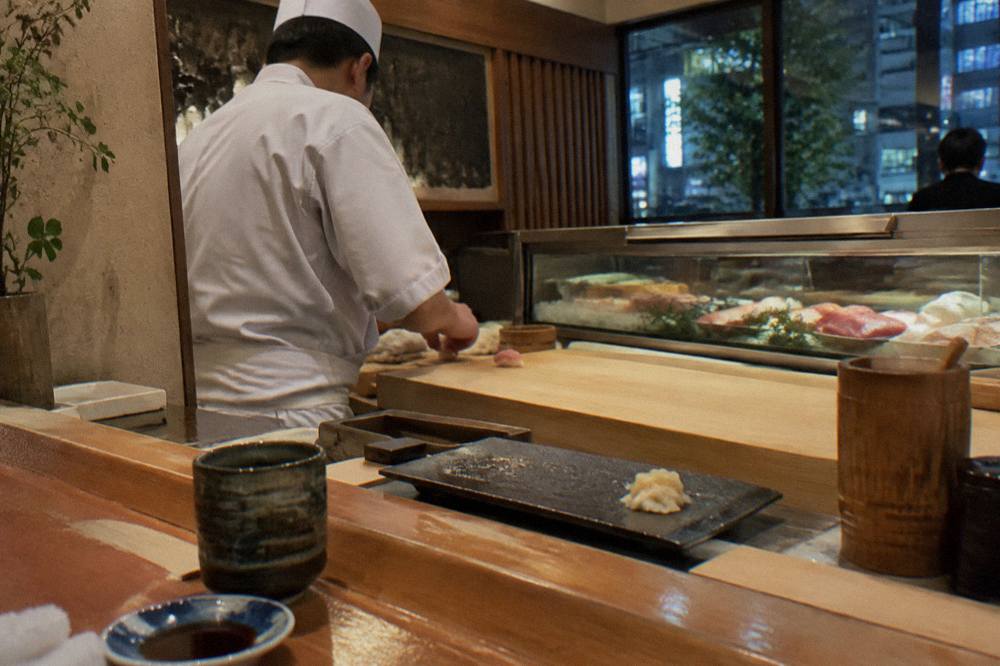
For popular omakase counters, reservations typically open about two months ahead, and availability can disappear within hours of release. Michelin partner OMAKASE and the Michelin Guide Tokyo advise booking starred restaurants one to two months ahead, typically via online services, a hotel concierge or the Michelin partner booking system. Cherry blossom and autumn foliage seasons compress those timelines further, so treat two months as the floor, not the average.
The mechanics are now largely platform driven rather than phone driven. Reporting by STAYGO on popular Tokyo omakase counters notes that reservations tend to open two months out, with timed release drops, and that some venues stagger seats in rounds rather than dumping the whole calendar at once. The same reporting describes venues that limit accounts to one booking every two months, and notes that lunch slots sometimes appear later even when the initial release day shows none. The practical lesson: check back, and do not read an empty calendar as a full one.
Tier discipline matters here. The one to two month figure for starred restaurants is solid, sourced from the Michelin ecosystem; the round by round release behaviour is venue specific and should be read as typical rather than universal. What is uniformly true is that the top counters in Ginza, Azabu and Akasaka plan their calendars further out than most visitors plan their trips.
The curated records show how differently the requirement bites across the city. Sushi Yuu in Azabu, expensive and booking usually required, is the archetype of the counter you plan around. Uogashi Nihon-Ichi, moderate and usually walk-in at 4.5 across 2,629 reviews, is the archetype you do not plan around at all. For a fuller walk through the restaurant side, see the best sushi counters in Tokyo, and for the reservation question in general, which Tokyo restaurants require reservations breaks the labels down across cuisines.
Planning a trip around fixed windows is exactly where a planning tool earns its keep. The Tokyo Food List, our own guide, sorts its 980+ listings by reservation difficulty and price range with booking links attached, so you can see in one screen which of your targets need a calendar alarm and which need nothing but an appetite.
Which Booking Platforms Work For Omakase Counters?
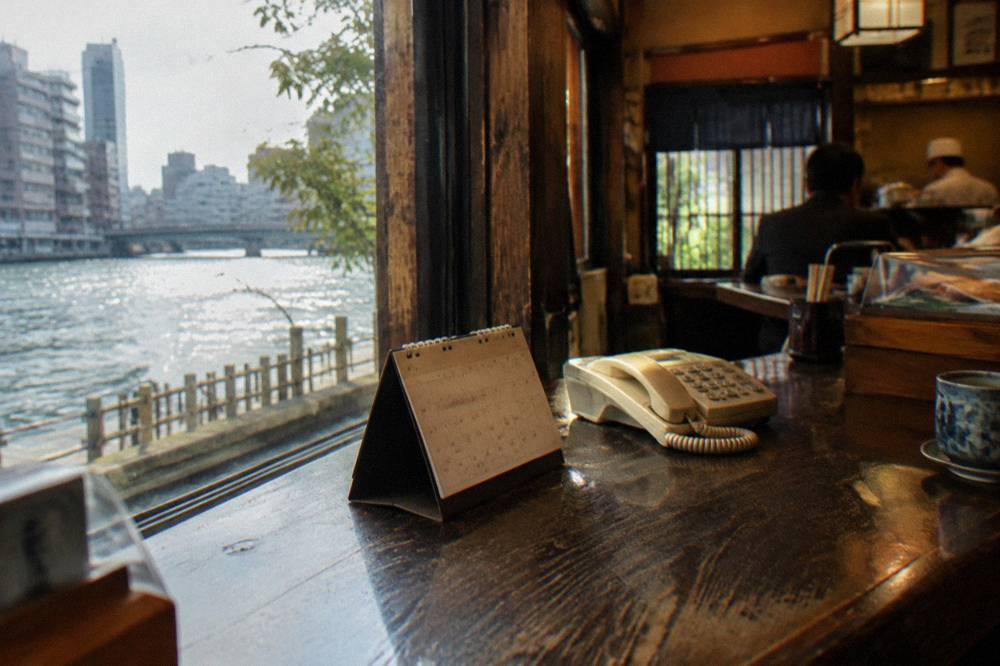
The main English friendly routes are the multilingual Tabelog booking service (about 440 yen per person, card required), OMAKASE (about 390 yen per seat, card registration required) and TableCheck, where a card is often needed for holds or prepayment. Many top counters still need a Japanese phone number or a Japanese speaker for phone only booking, and hotel concierges can bridge that gap. Fees are charged per seat, on top of the meal.
Those figures come from the platforms' own booking pages; treat them as typical rather than guaranteed, and read them off the live listing before you book. In practice OMAKASE works like this: registration requires an SMS-capable mobile number and a credit card, the interface is available in English, and the culture is entirely Japanese, meaning timed releases and strict cancellation terms. SHOKU NOREN's guide to the platform describes timed release drops often preceded by raffles that give winners priority booking.
One sushi restaurant's own announcement shows how fast this landscape moves: Sushi Tokinari posted that it switched its booking system from TableCheck to OMAKASE, changing from a card hold to full course prepayment at reservation. That single switch changes your exposure. A hold costs you nothing if you show up; prepayment means your money is in the restaurant's hands before your plane takes off. Check which model a counter uses before committing.
| Route | Typical fee | Card requirement | Best suited to |
|---|---|---|---|
| Multilingual Tabelog booking | about 440 yen per person | card required | Mid range counters with standard slots |
| OMAKASE | about 390 per seat, charged at booking | registration with card | Top counters using timed releases |
| TableCheck | usually no booking fee | card often needed for holds or prepayment | Restaurants holding seats against a card |
| Hotel concierge | none stated | varies by hotel | Phone only counters, including the most exclusive |
The concierge route deserves more respect than it gets. The counter at the very top of the market is phone only by design, precisely because a concierge mediated booking arrives with a guest the restaurant can trust to appear. For everyone else, the platforms above cover the vast majority of bookable omakase in the city.
For travellers who want the omakase format without any of this machinery, there is a third route: a guided experience. The Omakase Sushi and A5 Wagyu premium foodie tour runs from $130.73 per person, carries a 4.72 rating across 329 reviews, lasts 3 hours with a maximum of 8 travellers, and includes a meal and drinks with free cancellation. It is a group format rather than a solo reservation, which is exactly the point: someone else has already solved the booking problem. Check availability
What Are The Cancellation Rules At Omakase Restaurants?
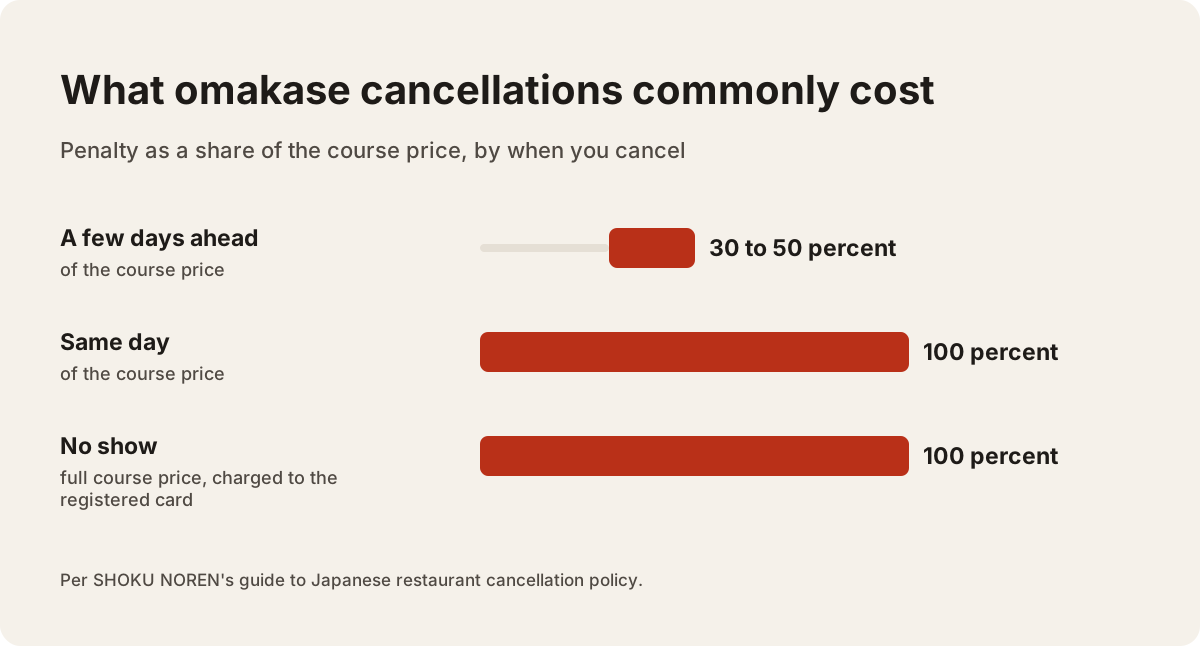
High end and omakase restaurants commonly charge 30 to 50 percent of the course price for cancellations a few days ahead, rising to 100 percent for same day cancellations and no shows, according to SHOKU NOREN's guide to Japanese restaurant cancellation policy. On booking platforms the fee is charged to your registered card under each restaurant's own policy, and the penalty clock can run from Japan Standard Time midnight, regardless of when you confirmed.
That midnight detail is the one that catches travellers. The platform's own support documentation states that the cancellation policy applies from Japan Standard Time 00:00 even on the confirmation day itself if you are inside the penalty window. A cancellation that feels like "three days out" from your departure city may already be inside the window when counted from Tokyo. Assume the strictest reading and you will not be surprised.
Free cancellation is therefore worth real money here, and it is worth checking for before you commit rather than after. The guided tours on this site carry it, but restaurant counters almost never do; the deposit exists precisely because the seat cannot be resold.
| When you cancel | What typically happens |
|---|---|
| A week or more ahead | Often no charge, or a small platform fee retained |
| A few days ahead | Commonly 30 to 50 percent of the course price |
| Same day | Commonly 100 percent of the course price |
| No show | Full course price, charged to the registered card |
This ladder is one source's single-venue-class claim rather than an official rule, so read it as typical: an inexpensive walk-in counter will not have a cancellation policy at all, since there is no reservation to cancel, while the expensive counters where booking is usually required, Sushi Yuu, Matsue Ebisu Head Store and Shabu Shabu & Sushi Hassan Roppongi, are where the percentages bite. The rule of thumb writes itself: the harder the counter is to book, the harder it punishes a withdrawal.
One more mechanic: OMAKASE's per seat fee at booking completion is non refundable even when the meal itself is not, so a user cancellation can cost you the fee on top of any course percentage. Budget for the total exposure, not just the menu.
What Does Omakase Cost In Tokyo?
There is no single omakase price in Tokyo, and this guide deliberately expresses the ladder in price levels rather than yen. Among the 16 curated sushi records, 4 sit in the inexpensive band, 8 in moderate, 4 in expensive, and the entry point for a real omakase sequence sits as low as the inexpensive counters such as Yakata-bune and Sushi Komagata, while the top of the curated ladder is expensive rather than very expensive. For a deeper treatment of the pricing question, why omakase is so expensive in Tokyo owns the full analysis.
The curated records let you see the ladder concretely. Komagata in Taito, inexpensive, usually walk-in, 4.8 on Google across 600 reviews, serves omakase and eel orders in a local crowd setting. Sushi Teppen Shibuya, moderate, booking recommended, 5.0 across 618 reviews, is the sweet spot most visitors should aim at: a genuine omakase and negitoro counter with a perfect rating and a manageable booking label. Sushi Yuu in Azabu, expensive and booking usually required, is where the fatty tuna order tag and the planning calendar meet. The rest of the planning pages sit on Best Restaurants Tokyo.
| Restaurant | Area | Google rating | Reviews | Price level | Booking label |
|---|---|---|---|---|---|
| Yakata-bune and Sushi Komagata | Taito | 4.8 | 600 | inexpensive | usually walk-in |
| Sushi Tooden Ninoya Shimbashi Shiodome | Minato | 4.8 | 644 | inexpensive | booking recommended |
| Sushi Mon Shinjuku | Shinjuku | 4.7 | 1,552 | inexpensive | usually walk-in |
| Shinjuku Sushi Hatsume | Shinjuku | 4.9 | 2,487 | moderate | booking recommended |
| TOKYO SUSHI ITAMAE SUSHI Shimbashi | Minato | 4.7 | 2,467 | moderate | booking recommended |
| Matsue Ebisu Head Store | Shibuya | 4.8 | 1,632 | expensive | booking usually required |
| Sushi Yuu | Minato | 4.8 | 504 | expensive | booking usually required |
The booking pattern across the whole sushi set is worth internalising: 4 of the 16 records are usually walk-in, 8 are booking recommended and 4 are booking usually required, and the requirement rises with price. None of the inexpensive records carries a booking usually required label. The takeaway is that Tokyo's omakase ladder is climbable from the bottom, and the bottom requires no booking at all.
What omakase cancellations commonly cost
The Michelin layer sits above all of this. The 2026 guide lists 160 starred restaurants in Tokyo, 12 three star, 26 two star and 122 one star, and its full selection totals 526 restaurants, per Michelin's own publication page. Above the starred tier, booking often runs through platforms such as Pocket Concierge, whose prepayment guarantees reduce no-show risk and make high-end counters more willing to accept international guests. For most travellers the starred counters are a separate sport; the moderate band on the table above is where the value lives.
Lunch Or Dinner: When Is Omakase Cheaper In Tokyo?
Lunch is usually far cheaper than dinner at the same sushi counter. Japan Brand Collection cites one Ginza counter where a lunch omakase runs about 9,000 yen against about 20,000 yen at dinner, an illustration from a single venue rather than a universal price table, and Japan Activity's Tokyo Michelin dining guide makes the same point: lunch tasting menus typically cost a fraction of the same establishment's dinner omakase.
The pattern holds across the market because of how counters are staffed. The same chef, the same fish and the same seats are cheaper at noon because demand is lower and covers fewer courses. For a visitor, this converts directly into strategy: take your one splurge counter at lunch, and spend the dinner slot on a walk-in or booking recommended moderate record from the table above.
There is a scheduling catch: many Tokyo restaurants close between lunch and dinner service, stop taking last orders before the stated closing time, and often close on Sundays, Mondays or national holidays, according to Japan Brand Collection. A lunch omakase plan therefore needs two checks, opening day and last order time, not one. A counter that looks open on a map may be dark on the exact Monday you earmarked.
Practically, the cheapest reliable omakase day plan looks like this: an inexpensive lunch counter such as Sushi Mon Shinjuku (4.7 on Google, 1,552 reviews, usually walk-in) or a Ninoya eel set in Shimbashi, then a moderate dinner booking at Sushi Teppen Shibuya or TOKYO SUSHI ITAMAE SUSHI Shimbashi, where bluefin tuna and fatty tuna lead the order tags. You get two ends of the ladder in one day without touching the booking usually required tier.
Walk-In Sushi Counters In Tokyo That Skip The Booking Game
Four of the 16 curated sushi records are labelled usually walk-in, and all of them sit in the inexpensive or moderate bands: Yakata-bune and Sushi Komagata, Sushi Mon Shinjuku, Uogashi Nihon-Ichi and R/Q. None of the inexpensive records carries a booking usually required label, which means the bottom of the omakase ladder is entirely accessible without a reservation, a platform fee or a card guarantee.
Standing and counter formats are the backbone of this tier. Uogashi Nihon-Ichi, 4.5 on Google across 2,629 reviews, sits in the moderate band, is labelled usually walk-in and draws a mixed crowd. R/Q in the moderate band, 4.9 across 680 reviews, is the quiet star of the set: a near perfect rating on a solid review pool with no booking barrier at all.
Some etiquette notes matter most at this tier. At conveyor belt and standing venues, once your hand touches a plate on the belt that plate is yours and must not go back, per japanmanners.com's conveyor sushi guide, which also notes that many venues now use touchscreens for custom orders delivered separately and that stacking empty plates neatly by colour makes billing easy. Counter seats turn over quickly, so the norm is to eat and move rather than linger, the same pattern Tokyo ramen etiquette guides describe.
For halal, vegan and allergy questions at any counter, the same caution applies everywhere: confirm with the restaurant directly, since broth and seasoning ingredients such as dashi do not appear on the plate. The dedicated dietary guide for Tokyo covers that ground in full.
If you want the skills behind the counter rather than the seat in front of it, the Sushi Making Class in Asakusa runs from $44.93 per person with a 4.94 rating across 206 reviews, 90 minutes, meal and drinks included, free cancellation. It is the least expensive conversion of omakase curiosity into an actual experience anywhere on this site's roster.
The class pairs naturally with a walk-in counter meal: you learn the craft in the afternoon, then watch a professional do it properly at Komagata or Uogashi Nihon-Ichi in the evening, with nothing booked in advance at either.
What To Expect At The Omakase Counter
Expect a chef-paced, sequenced meal where pieces arrive one at a time and you eat each as it lands, with the progression moving from lighter items toward richer ones, so fatty tuna and sea urchin come classically late. The chef sets the pace, making the counter experience closer to a tasting menu than a standard order.
Payment and service norms are simpler than the booking layer. Tipping is not customary in Japanese restaurants and staff may return a tip left behind, and some higher end and hotel restaurants add an automatic service charge of 10 to 15 percent instead, so there is nothing to calculate at the table. Tax is already inside displayed prices: dine in carries 10 percent consumption tax and takeout 8 percent, and menus must show tax included figures.
Behaviour at the counter is mostly pacing. Do not save pieces, do not photograph every course at the expense of eating, and do not treat the sequence as negotiable. Two tax and payment notes worth carrying: many small counters remain cash only or cash plus IC card, with no uniform policy, so carry some cash; and if a venue serves alcohol after midnight it has filed a late night notification with the public safety commission, which is trivia everywhere except when you wonder why a counter stops pouring at a precise minute.
Counter culture ends where this guide began: the seat is the product. Whether it is an inexpensive stand-up set at Komagata or an expensive booked seat at Sushi Yuu, the transaction is the same, one chair, one chef, one sequence decided by someone else. Best Restaurants Tokyo exists to make that transaction legible, from the walk-in labels to the cancellation ladders.
If a self guided counter night still feels like a research project, the Omakase Sushi and A5 Wagyu premium foodie tour bundles the format into one 3 hour evening, from $130.73 per person, 4.72 across 329 reviews, maximum 8 travellers, meal and drinks included, free cancellation. Check availability
For a different angle on the same appetite, the Tsukiji Market walking tour with 5 tastings runs from $97.17 per person, 4.9 across 3,868 reviews, 3 hours, meal included, and pairs naturally with the walk-in counter tier described above.
Common Questions About Omakase In Tokyo
What is omakase?
Omakase means "I leave it up to you": the diner hands the choice to the chef, who builds a sequence from the day's market. In Tokyo it most often takes the form of a sushi counter where pieces arrive one at a time, progressing from lighter fish toward richer ones such as fatty tuna and sea urchin. It exists at every price level, from inexpensive walk-in counters to expensive booked seats.
How far ahead should I book omakase in Tokyo?
Popular counters typically open reservations about two months ahead, and availability can disappear quickly, especially during cherry blossom and autumn foliage seasons. Michelin advises reserving one to two months ahead for starred restaurants, typically through online booking services, a hotel concierge or its official partner system. Walk-in counters in the inexpensive band need no booking at all.
What fees do omakase booking platforms charge?
According to NativeCall, multilingual Tabelog charges about 440 yen for each person and requires a card, OMAKASE charges about 390 yen for each seat with card registration, and TableCheck often needs a card for holds or prepayment. Fees sit on top of the meal price and can be non refundable. Confirm current figures on the live listing before booking.
What happens if I cancel an omakase reservation?
High end and omakase restaurants commonly charge 30 to 50 percent of the course price for cancellations a few days ahead, rising to 100 percent for same day cancellations and no shows, per SHOKU NOREN's guide to Japanese restaurant cancellation policy. On booking platforms the charge goes to your registered card, and the penalty window is calculated from Japan Standard Time midnight regardless of when you confirmed.
Is lunch really cheaper than dinner for omakase?
Usually, yes. Japan Brand Collection cites one Ginza counter where lunch omakase runs about 9,000 yen against about 20,000 yen at dinner. Lunch tasting menus at starred Tokyo kitchens typically cost a fraction of dinner omakase at the same establishment. Note that many restaurants close between services and often close on Sundays, Mondays or national holidays, so check both the day and the last order time.
Can I get omakase in Tokyo without a reservation?
Yes. Among the 16 curated sushi records on this site, four are labelled usually walk-in, including Yakata-bune and Sushi Komagata, Sushi Mon Shinjuku, Uogashi Nihon-Ichi and R/Q, all in the inexpensive or moderate bands. None of the inexpensive records requires a booking, so the entry level of the omakase ladder is fully accessible without platforms, fees or card guarantees.