Wagyu And Teppanyaki In Tokyo: Steakhouses, Yakiniku And What The Grade Means
Ten wagyu records across yakiniku, teppanyaki and gyukatsu, mostly priced moderate and labelled booking recommended, plus the official grading rules behind the letters and numbers on the menu.
Short answer
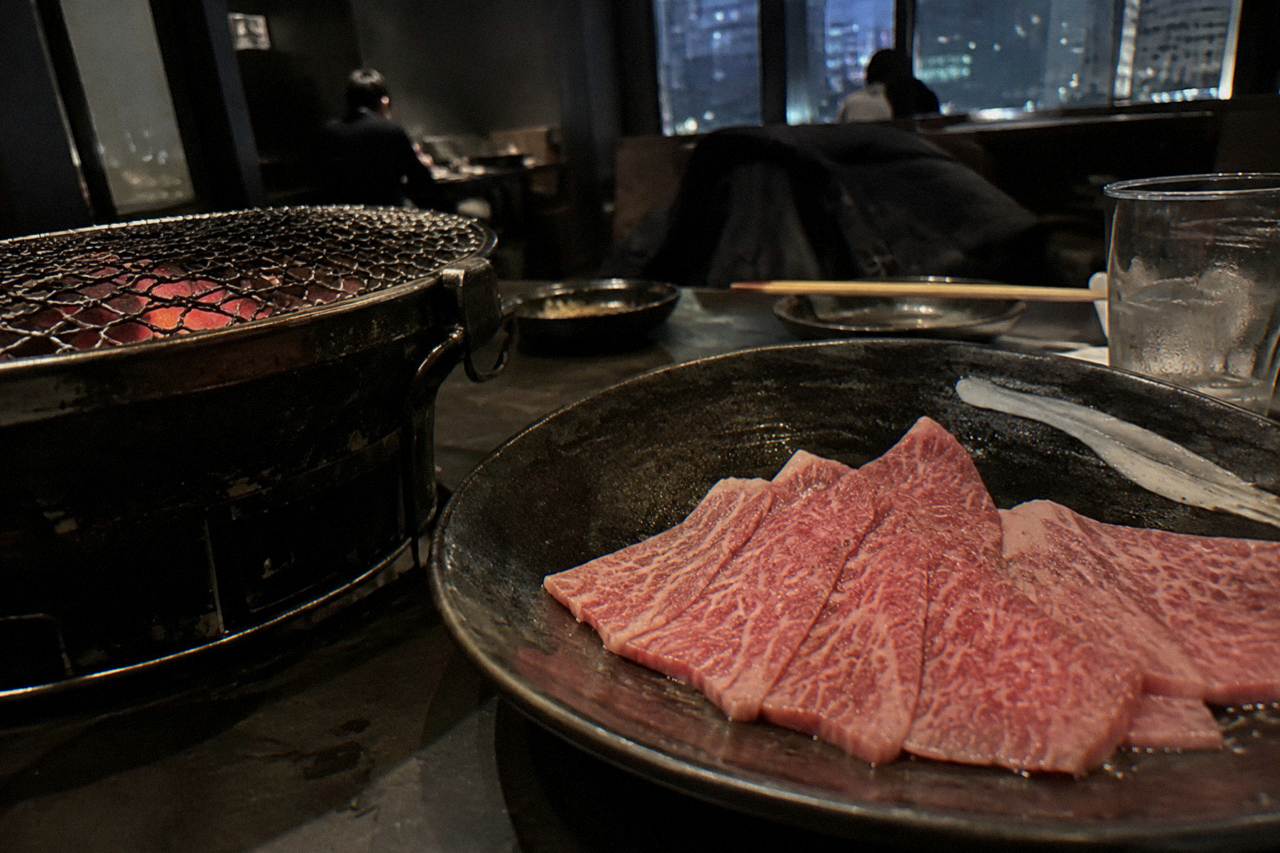
The wagyu records on this site run from inexpensive gyukatsu counters to moderate yakiniku and teppanyaki rooms; nine of the ten carry a booking recommended label. The A5 grade means top yield and top meat quality on Japan's official two-axis scale, and lunch is typically the cheaper way into the same kitchens.
Kobe Beef Dia Shibuya 1st store sits at 4.9 on Google across 3,829 reviews, priced moderate, labelled booking recommended, with kobe beef and teppanyaki on its order tags. That single record is a fair summary of wagyu dining in Tokyo as the data shows it: high ratings, mid-range price bands, and a table you generally need to reserve. The ten wagyu records on this site, one of 980+ entries in our own guide, The Tokyo Food List, span three very different formats, yakiniku where you grill yourself, teppanyaki where a chef cooks on an iron plate, and gyukatsu counters serving breaded beef cutlets, and the format matters as much as the grade when you are deciding where to spend the money. One more record, GYUMON Ueno, files under ramen but carries gyukatsu, gyoza and wagyu order tags, which tells you how far the word has travelled downmarket.
What Does The Wagyu Grade Actually Mean?
A5 is the top of a two-axis scale run by the Japan Meat Grading Association: a letter for yield and a number for meat quality, and the two measure different things. Yield grades A, B and C estimate how much usable meat a carcass gives a processor; quality grades 1 to 5 score marbling, colour, firmness and fat quality on the meat itself. A5 means grade A yield plus grade 5 quality, the best score on both axes.
The quality number is the one that matters to a diner, and it is decided by the lowest of four component scores. According to the grading explained by Peak Wagyu, a journal covering the Japan Meat Grading Association system, grade 5 requires a Beef Marbling Standard, or BMS, of 8 to 12, alongside top marks for meat colour and brightness, firmness and texture, and fat colour and quality. The marbling itself is read visually on the ribeye cross-section between the sixth and seventh ribs, as First Agri's wagyu grading explainer sets out. BMS runs 1 to 12, so grade 5 covers a band, not a single point.
Two clarifications follow from the official rules and save real confusion at the counter. First, A5 does not mean BMS 12; it means quality grade 5, which covers BMS 8 to 12, so two A5 cuts can marble quite differently. Second, yield grade measures economic efficiency for the butcher and does not affect eating quality: a B-grade carcass can produce meat identical in taste and marbling to an A-grade one, as Wagyu Ninja's grade guide puts it. If a menu boasts a BMS number rather than a grade, that is the more precise claim. Counters like this sit in The Tokyo Food List too, among 980+ restaurants sorted by Google ratings and price ranges, with what to order and booking links.
The word wagyu itself is regulated. Under the 2025 Meat Display Handbook published by the national fair trade council for meat, only meat from the four specific Wagyu breeds, Japanese Black, Japanese Brown, Japanese Shorthorn and Japanese Polled, or their crosses, verified by traceability documents, may carry the label, and misleading use on other beef is prohibited. Every animal carries a 10-digit individual identification number, and restaurants serving yakiniku, shabu-shabu, sukiyaki or steak must be able to show the number or certificates for branded or graded beef. When a Tokyo steakhouse names a farm or a prefecture brand, that traceability chain is what stands behind it.
| Term | What it measures | Range | What the top score means |
|---|---|---|---|
| Yield grade (the letter) | Estimated proportion of usable meat on the carcass | A, B or C | A means roughly 72 percent or higher usable yield |
| Meat quality grade (the number) | Marbling, colour, firmness, fat quality | 1 to 5 | 5 is the highest, set by the lowest component score |
| BMS (Beef Marbling Standard) | Visible marbling on the ribeye cross-section | 1 to 12 | Only 8 to 12 qualifies a carcass for grade 5 |
| A5 | Yield A plus quality 5 | Top of both axes | Covers BMS 8 to 12, not only 12 |
| Traceability number | Individual animal ID under Japan's beef rules | 10 digits | Must be displayable by restaurants serving graded beef |
Where To Eat Wagyu In Tokyo: The Records On This Site
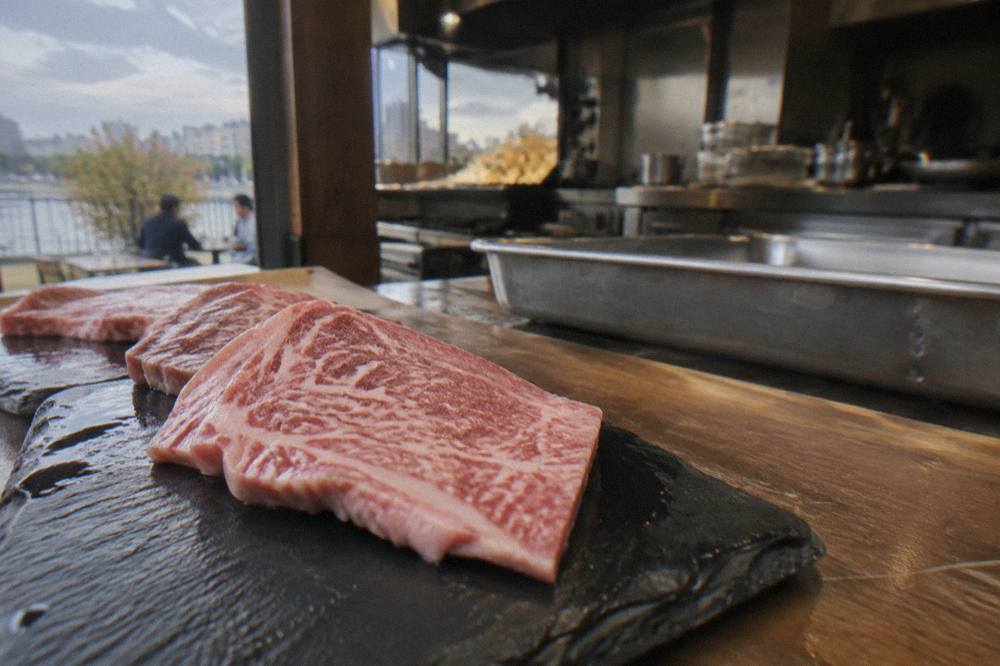
The ten wagyu records on this site span yakiniku, teppanyaki and gyukatsu formats across seven Tokyo wards, and every one holds a Google rating of 4.7 or higher. All ten are priced moderate or inexpensive, nine carry the booking recommended label, and only Wagyu Halal Japanese Food Shinjuku Restaurant is usually walk-in.
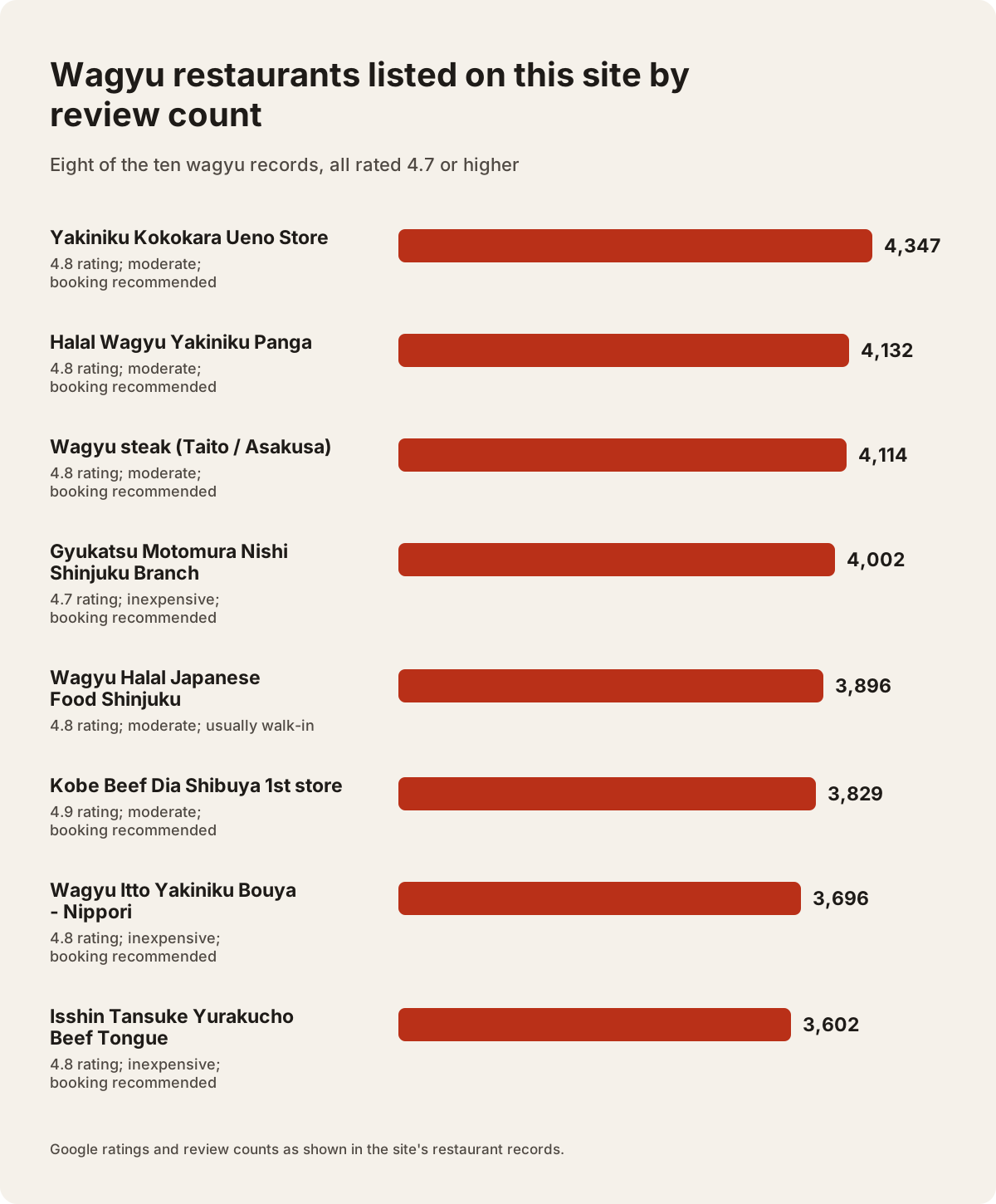
Read the table as a shortlist, not a ranking: Google ratings with review counts this large are a signal of consistency, not a verdict on which beef is better. Yakiniku Kokokara Ueno Store, at 4.8 across 4,347 reviews, is the most reviewed of the ten, with thick beef tongue and a platter among its order tags. YAKINIKUMAFIA IKEBUKURO by WAGYUMAFIA lists ozaki beef among its order tags, one of the named farm brands the traceability rules above are built to protect. At the inexpensive end, Wagyu Itto Yakiniku Bouya in Nippori, 4.8 across 3,696 reviews, and Isshin Tansuke in Yurakucho, 4.8 across 3,602 reviews, prove that the format does not require an expensive price band.
| Restaurant | Ward / area | Google rating | Reviews | Price level | Booking label | Crowd label |
|---|---|---|---|---|---|---|
| Kobe Beef Dia Shibuya 1st store | Shibuya | 4.9 | 3,829 | moderate | booking recommended | mixed |
| Yakiniku Kokokara Ueno Store | Taito / Ueno | 4.8 | 4,347 | moderate | booking recommended | mixed |
| Halal Wagyu Yakiniku Panga | Taito | 4.8 | 4,132 | moderate | booking recommended | tourist |
| Wagyu steak | Taito / Asakusa | 4.8 | 4,114 | moderate | booking recommended | mixed |
| Wagyu Halal Japanese Food Shinjuku Restaurant | Shinjuku | 4.8 | 3,896 | moderate | usually walk-in | tourist |
| YAKINIKUMAFIA IKEBUKURO by WAGYUMAFIA | Toshima / Ikebukuro | 4.8 | 3,888 | moderate | booking recommended | mixed |
| Wagyu Itto Yakiniku Bouya - Nippori | Arakawa / Nippori | 4.8 | 3,696 | inexpensive | booking recommended | mixed |
| Isshin Tansuke Yurakucho Beef Tongue | Chiyoda / Yurakucho | 4.8 | 3,602 | inexpensive | booking recommended | mixed |
| Yakiniku Happy | Chuo / Nihonbashi | 4.8 | 3,377 | moderate | booking recommended | mixed |
| Gyukatsu Motomura Nishi Shinjuku Branch | Shinjuku | 4.7 | 4,002 | inexpensive | booking recommended | mixed |
The order tags tell you what to point at. Yakiniku Happy lists thick-cut beef tongue, rib fingers and green onion tongue salt; Isshin Tansuke Yurakucho lists thick-cut beef tongue and hamburger steak; Gyukatsu Motomura Nishi Shinjuku lists gyukatsu and wasabi. If you want the full picture of what to order at each address, reservation difficulty and booking links for each, The Tokyo Food List, our own guide, sorts its 980+ entries by cuisine, Google rating and price range and opens cleanly on a phone so you can pick by neighbourhood on the walk there.
Teppanyaki, Yakiniku Or Gyukatsu: Which Wagyu Format Suits You?
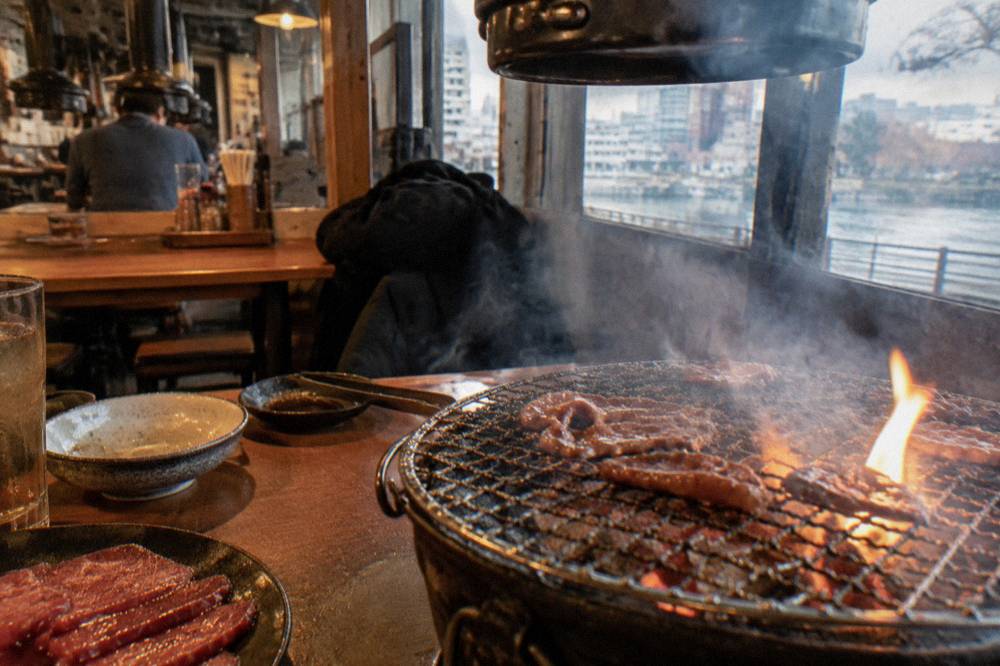
The three formats differ in who cooks and how fast the bill climbs. Yakiniku puts thin slices on a grill in front of you and typically sits moderate on Google listings; teppanyaki is a chef cooking on a flat iron plate at a counter, priced moderate too; gyukatsu is a deep-fried breaded cutlet at an inexpensive counter with fast turnover. All ten wagyu restaurants on this site land in the moderate or inexpensive bands.
The distinction is not just mechanical. As the comparison drawn by Asami's dining guide puts it, teppanyaki is chef-led cooking on a large flat iron plate, while yakiniku is closer to Japanese barbecue where diners grill thin, bite-sized slices themselves, often over gas or charcoal. Teppanyaki buys you theatre and pacing: the chef works the plate in front of you. Yakiniku buys you control: you decide when each slice comes off the fire. Gyukatsu buys you neither, but at an inexpensive price band with a 4.7 rating across 4,002 reviews at the Nishi Shinjuku Motomura branch, it is the cheapest credible way to taste wagyu-textured beef on this list.
| Format | Who cooks | Typical venue among our picks | Price band here | What you are paying for |
|---|---|---|---|---|
| Yakiniku | You, on a tabletop grill | Yakiniku Kokokara, Yakiniku Happy, YAKINIKUMAFIA | moderate, two inexpensive | Control over doneness, many small cuts |
| Teppanyaki | Chef, on an iron plate | Kobe Beef Dia Shibuya 1st store | moderate | Seated theatre, precise searing of named beef |
| Gyukatsu | Kitchen, fried to order | Gyukatsu Motomura Nishi Shinjuku, GYUMON Ueno | inexpensive | Speed and a low entry price |
| Wagyu in ramen form | Kitchen | GYUMON Ueno | inexpensive | Wagyu tags alongside gyukatsu and gyoza |
GYUMON Ueno deserves its own line: a ramen record at heart, 4.8 on Google across 4,254 reviews, priced inexpensive, labelled booking recommended, with gyukatsu, gyoza and wagyu among its order tags. It is the clearest example in the data of wagyu vocabulary reaching the inexpensive band. Our guide to ramen in Tokyo covers the broth side of that menu; here it simply widens the price range for a wagyu-adjacent meal to the cheapest entry on the page.
How Much Does Wagyu Cost In Tokyo?
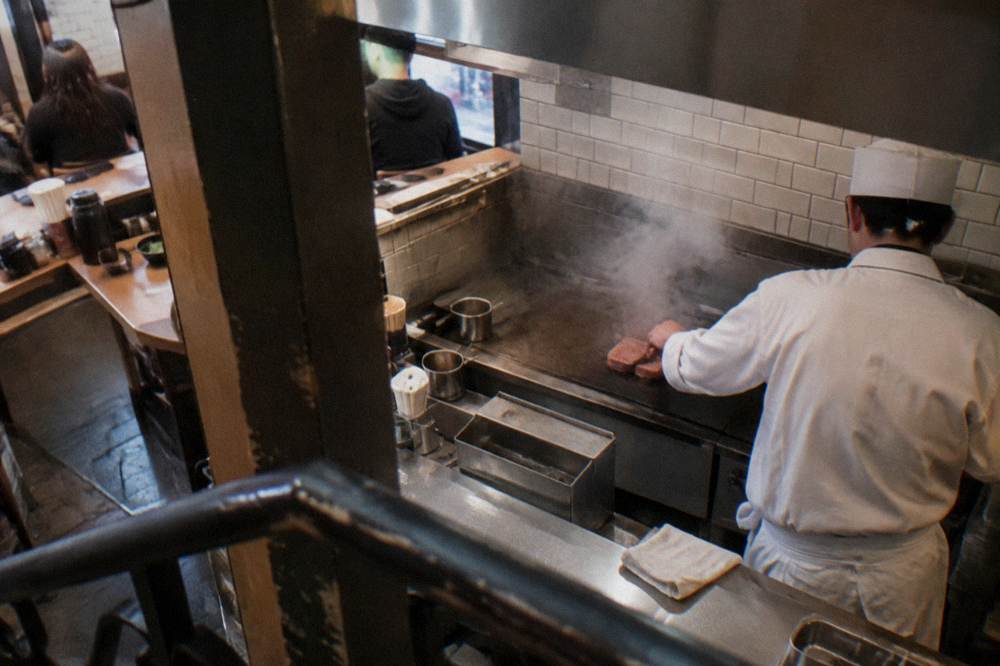
Wagyu is not automatically an expensive night: of the ten wagyu restaurants on this site, seven sit in the moderate band and three in the inexpensive band, with none labelled expensive or very expensive. Elsewhere among our 100 picks, sushi holds 4 expensive entries and none very expensive, while dessert, udon, yakitori and breakfast top out at moderate or below. The grade, the cut and the format, not the word wagyu, set the price.
The price-level labels here are Food List bands, so read them as ranges rather than sums. A moderate yakiniku room where you grill tongue and rib fingers yourself sits far from a moderate teppanyaki counter serving named-brand beef, even though both carry the same band label. What the data does show is a cuisine with an unusually gentle slope: you can enter at Gyukatsu Motomura or Wagyu Itto Yakiniku Bouya in the inexpensive band and step up to Kobe Beef Dia Shibuya without ever crossing into the very expensive territory sushi occupies in our omakase guide.
Two market facts help calibrate expectations. A Guide2Japan analysis of Tokyo wagyu venues found that lunch courses at teppanyaki and premium yakiniku houses are frequently priced at roughly half the cost of the equivalent dinner course using the same ingredients and the same chef. And demand, not supply, is the constraint: the same analysis notes that high-end Tokyo yakiniku houses including Yoroniku, Yakiniku Yazawa Tokyo and Sumibi Yakiniku Nakahara have discontinued phone reservations and take online bookings only, with weekend slots filling first.
Wagyu restaurants listed on this site by review count
Is Lunch The Cheaper Door For Wagyu In Tokyo?
Yes, typically. Guide2Japan's wagyu guide for Tokyo reports that lunch courses at teppanyaki and yakiniku restaurants are frequently priced at roughly half the equivalent dinner course, with the same ingredients and the same chef. The Google listings tell a similar story: nine of the ten wagyu restaurants on this site carry a booking recommended label, so lunch is both cheaper and easier to secure than a weekend dinner slot.
The half-price claim comes from Guide2Japan's 2026 wagyu guide, which uses Ginza Ukai-tei's lunch course as its worked example, roughly half the dinner price for the same teppan and the same chef. Treat it as a pattern rather than a promise: individual venues rarely publish a clean lunch-versus-dinner comparison up front, so check the live listing or the restaurant's own site. But the pattern holds widely enough that a wagyu lunch at 1 p.m. and a cheap dinner elsewhere is a legitimate strategy on a moderate budget, and it fits what Japan Brand Collection, working with japan-guide.com, reports about Tokyo restaurants generally, that many close between lunch and dinner service and often close on Sundays, Mondays or national holidays, so the lunch sitting may be your only sitting on some days.
Booking windows reinforce the lunch route. Izakaya Manual's guide to wagyu dining in Tokyo reports that premium teppanyaki and yakiniku counters generally need reservations two to six weeks ahead, longer in peak seasons, while casual chains and solo weekday lunches may allow walk-ins. The only usually walk-in label among the restaurants on this site, Wagyu Halal Japanese Food Shinjuku Restaurant, is an exception worth knowing about rather than a rule.
If you would rather have someone else arrange the premium evening, the Omakase Sushi and A5 Wagyu tour bundles both formats in one three-hour seated experience: from $130.73 per person, 4.72 across 329 reviews, a meal and drinks included, a maximum of eight travellers and free cancellation. It is a fixed, known price in a category where à la carte bills are the risk.
How To Book A Wagyu Restaurant In Tokyo
Nine of the ten wagyu records carry the booking recommended label, and the booking systems that matter are Tabelog multilingual booking, OMAKASE and TableCheck, each with a per-seat or per-person fee and a card requirement. Top yakiniku rooms have closed their phone lines entirely and take online bookings only. High-end cancellation penalties typically run 30 to 50 percent of the course price days ahead, rising to 100 percent for same-day.
Those booking systems and their fees are laid out in NativeCall's guide to Japan restaurant booking apps: Tabelog's multilingual service charges each diner about 440 yen and requires a card, OMAKASE takes about 390 yen a seat with card registration, and TableCheck often needs a card for holds or prepayment. Many top places still want a Japanese phone number or a Japanese speaker for phone-only booking, and a hotel concierge can bridge that gap. The cancellation warning bears repeating for wagyu specifically. Course prices run high enough that a same-day no-show can cost the full amount. Our blog post on how to make restaurant reservations in Japan walks through each system's mechanics.
For the specific restaurants above, the operator's own site is the place to check: the record for Kobe Beef Dia Shibuya 1st store lists its teppanyaki counter's page, and each entry in The Tokyo Food List carries its booking link beside its reservation-difficulty label. Between the booking label, the crowd label and the order tags, you can decide before you commit whether a room suits a quiet dinner or a lively group grill.
An evening built around yakiniku and bar hopping is another structure entirely: the Bar Hop, Free Flow Full Dinner tour in Shinjuku runs three hours from $109.35 per person, 4.9 across 4,086 reviews, maximum seven travellers, with a full dinner and drinks included and free cancellation. It pairs the grill-and-drink rhythm of yakiniku with the Golden Gai bar lanes, which our izakaya and yakitori guide covers in detail.
Are There Halal Wagyu Options In Tokyo?
Yes, three of the ten records carry a halal flag: Halal Wagyu Yakiniku Panga in Taito and Wagyu Halal Japanese Food Shinjuku Restaurant in Shinjuku both name it directly, while Wagyu steak in Asakusa points to a halal wagyu site on its listing. All three sit at 4.8 on Google. The flag is what the record supports; certification status is not in the data, so confirm directly with the restaurant before booking.
That last sentence is the honest limit of the record lines. The restaurant names contain the word halal, and reporting them as such is fair; writing certified halal would go beyond what the data holds. For context, Japan has multiple halal certification bodies, including the religious corporation Japan Muslim Association in Tokyo and the Muslim Professional Japan Association, which was recognised by Singapore's MUIS certifier in 2026, per the HalalJapan registry and MPJA's own page. The broader halal dining landscape, including the dashi problem in ordinary kitchens, is covered in our dietary guide.
What To Order And How To Behave At A Wagyu Counter
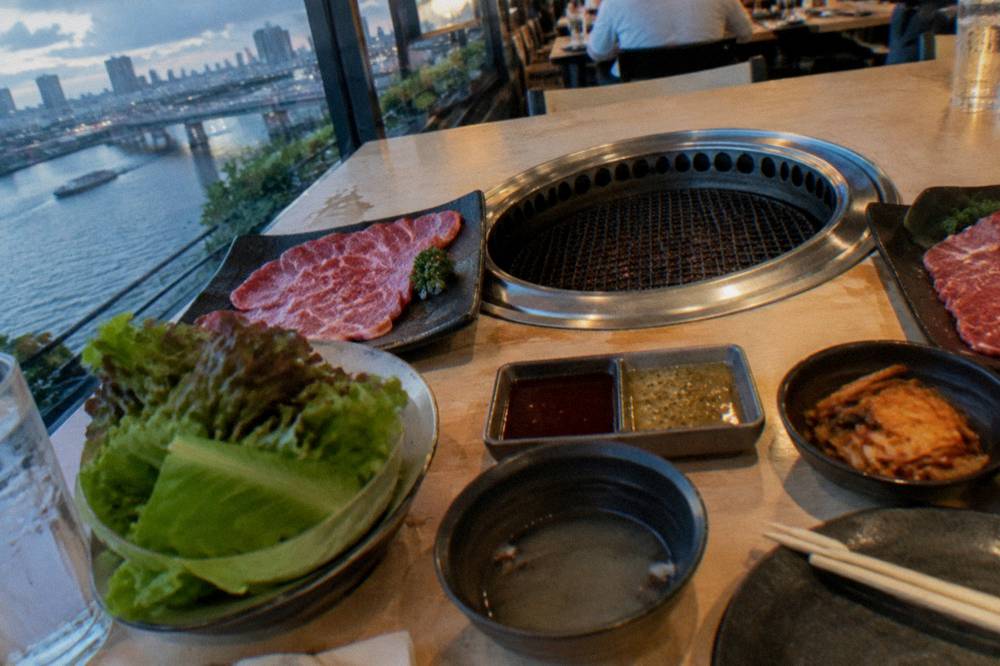
Order tags across the restaurants on this site lean toward thick-cut and thick beef tongue at yakiniku rooms, platters and named beef at the premium end, and gyukatsu with wasabi at the cutlet counters. At teppanyaki the chef paces the meal; at yakiniku you pace it yourself. Tipping is not customary, a 10 percent consumption tax applies to dine-in, and otoshi table charges may appear at izakaya-style rooms.
The etiquette load is lighter than at a sushi counter, but a few mechanics help. Wagyu is fattier than most beef, so yakiniku rooms serve it in thin slices that cook in seconds; the order tags at Yakiniku Happy, green onion tongue salt alongside rib fingers, describe a typical progression from lean tongue to richer cuts. The tipping rule in Tokyo: tips are not customary and staff may return money left behind, while some higher-end and hotel restaurants add an automatic service charge of 10 to 15 percent instead. The dine-in takeout tax split also matters if you order takeaway from a wagyu burger counter such as the Wagyu steak record in Asakusa, which lists a juicy burger among its order tags: dine-in carries 10 percent consumption tax, takeout the reduced 8 percent rate.
The 100 restaurants on this site all hold a Google rating of 4.2 or higher and at least 300 reviews, so this wagyu page works as a shortlist cut from a far longer one. That longer list is The Tokyo Food List, our own $9 guide: 980+ restaurants with Google Maps pins, what to order, reservation difficulty and booking links, and updates land on the same link. If this page settled the format for you, the guide carries that decision into any neighbourhood of the city. That, in the end, is what Best Restaurants Tokyo is for.
Common Questions About Wagyu And Teppanyaki In Tokyo
What does A5 wagyu actually mean?
A5 is the top score on Japan's official two-axis grading scale: yield grade A for usable meat proportion, and meat quality grade 5 for marbling, colour, firmness and fat quality. Grade 5 requires a Beef Marbling Standard of 8 to 12, so A5 covers a band rather than one exact marbling level.
Is wagyu in Tokyo always expensive?
No. Seven of the ten wagyu restaurants on this site fall in the moderate band and three in the inexpensive band, with none in the expensive or very expensive bands. Gyukatsu counters and yakiniku rooms in the inexpensive band, such as the Nippori and Yurakucho spots, sit at 4.8 on Google.
What is the difference between teppanyaki and yakiniku?
Teppanyaki is chef-led cooking on a large flat iron plate in front of guests; yakiniku has diners grill thin, bite-sized slices themselves on a tabletop grill. Kobe Beef Dia Shibuya is the teppanyaki record here; most of the rest are yakiniku rooms.
Do I need a reservation for wagyu restaurants in Tokyo?
Typically yes: nine of the ten wagyu records carry a booking recommended label, and reporting on premium venues suggests reservations two to six weeks ahead, longer in peak seasons. Only one record, the Shinjuku halal wagyu restaurant, is labelled usually walk-in.
Are there halal wagyu restaurants in Tokyo?
Yes, though options are limited. Three of the ten wagyu records here are halal-flagged on their listings. The flag is a data label rather than a certificate, so confirm preparation and certification directly with each restaurant before you book.
Is lunch cheaper than dinner for wagyu in Tokyo?
Typically, yes. Reporting on Tokyo's premium venues found lunch courses frequently priced at roughly half the equivalent dinner course with the same ingredients and chef, which makes lunch both the cheaper and the easier sitting to book.