Michelin Star Restaurants In Tokyo: Which Ones You Can Actually Book
Tokyo holds more Michelin-starred restaurants than any other city, and the 2026 guide confirms it for the nineteenth straight year. The hard part is not finding a starred kitchen, it is getting a seat at one. Here is what the 2026 edition actually lists, when seats open, which booking routes work for visitors, and what a cancellation really costs.
Short answer
The MICHELIN Guide Tokyo 2026 lists 160 starred restaurants: 12 three-star, 26 two-star and 122 one-star, part of a 526-restaurant selection. Seats at sought-after counters typically open one to two months ahead. Visitor-friendly routes include Tabelog multilingual booking, OMAKASE and TableCheck, and hotel concierges for phone-only venues.
Tokyo leads the world in Michelin stars, and the 2026 guide makes it nineteen consecutive years at the top, as Tokyo Smart notes in its coverage of the edition. That headline number hides the real problem for a visitor: most of those 160 starred seats are controlled by booking systems built for local regulars, phone lines that only speak Japanese, and cancellation policies that bite hard. Booking difficulty, not price, is the actual barrier to eating at a top Tokyo counter, and understanding that difficulty is where our own guide, The Tokyo Food List, earns its keep, with reservation difficulty labels and booking links for 980+ Tokyo restaurants. If wagyu counters are what actually drew you to Tokyo, our wagyu and teppanyaki guide for Tokyo explains what the beef grades mean and where to find the best steakhouses and yakiniku.
This page works through the numbers first, then the mechanics: when seats open, which booking routes work in English, what cancellations cost, why lunch is the cheaper way into a starred kitchen, and which high-difficulty alternatives the Food List labels as booking recommended or booking usually required when the starred counters are closed to you. None of the restaurants on this site carry a stated star, so what follows keeps Michelin's official counts apart from the bookable alternatives.
How Many Michelin Star Restaurants Does Tokyo Have?
Tokyo's 2026 Michelin total is 160 starred restaurants, split into 12 three-star, 26 two-star and 122 one-star establishments, out of a full selection of 526 restaurants. Michelin's own publication page lists the breakdown, and it marks the nineteenth consecutive edition in which Tokyo tops the world's cities for starred dining. Those numbers are the edition count, not a live guarantee of who holds a star today. The MICHELIN Guide Tokyo 2026 selection was announced digitally on 25 September 2025 and released in print at the end of that month, per Michelin Japan's own release. That timing matters for planners: a guide announced in September is the reference for the whole following year. Star counts move between editions, so a restaurant you read about in an older article may have gained, lost or exited entirely.
Tokyo Michelin Guide 2026: How the Selection Breaks Down
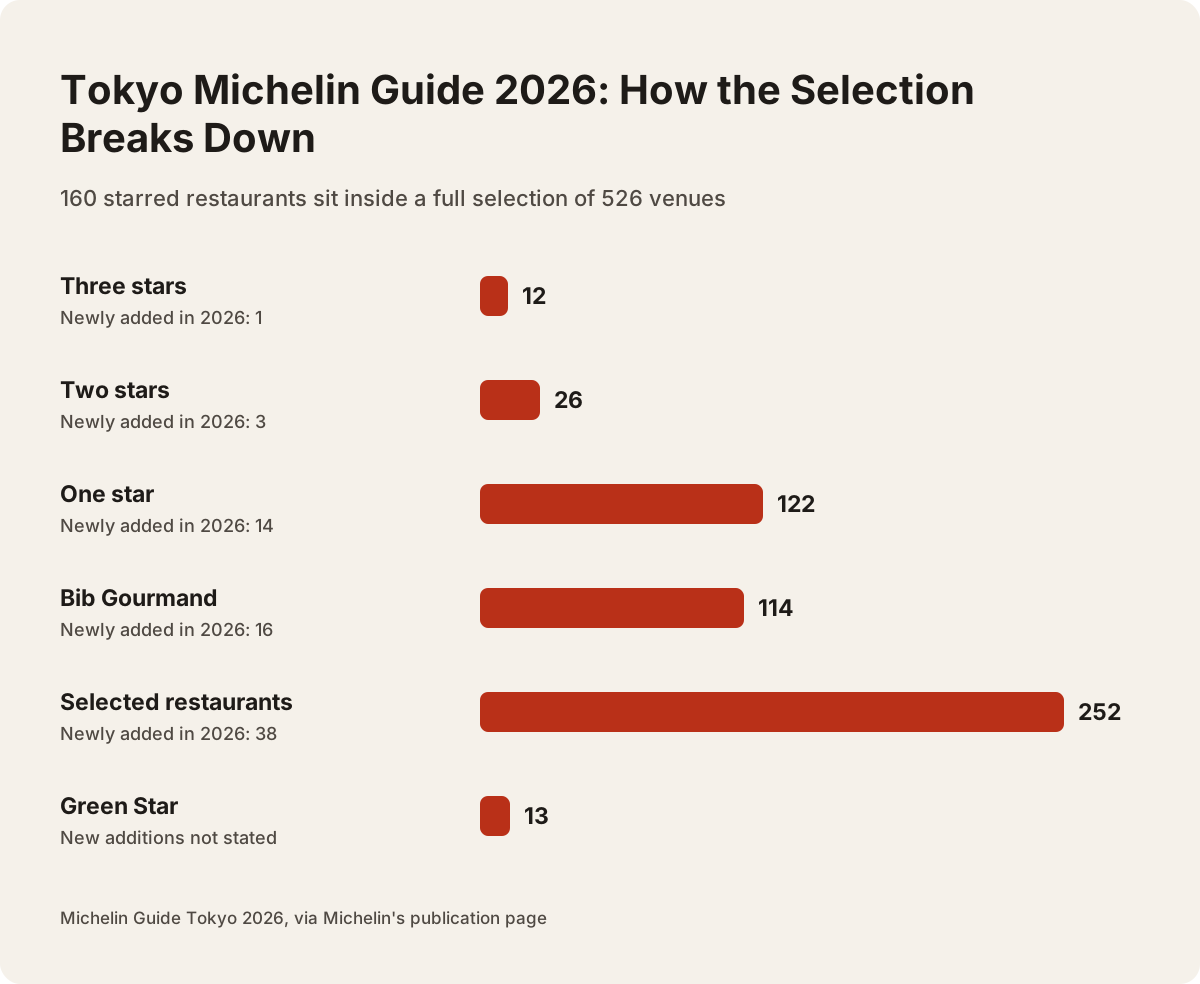
| Level | Restaurants | Newly added in 2026 |
|---|---|---|
| Three stars | 12 | 1 |
| Two stars | 26 | 3 |
| One star | 122 | 14 |
| Bib Gourmand | 114 | 16 |
| Selected restaurants | 252 | 38 |
| Green Star | 13 | not stated |
The Bib Gourmand line deserves attention. Those 114 entries are the guide's value label, and the 2026 edition widened them across 37 culinary categories, with creative dessert-course venues rising from two to six year over year, as Kawa-Colle Media reported from the announcement. If your goal is eating brilliantly rather than collecting stars, the Bib list is where the queues are shorter and the bills are kinder, a theme our cheap eats in Tokyo guide develops across the whole budget end of the city.
When Do Starred Counter Seats Actually Open?
Seats at the most sought-after Tokyo counters typically open on a set schedule one to two months ahead, and availability disappears quickly once they do. Traveljapan Together's guide to starred Tokyo dining describes exactly this pattern, and reservation platforms report that cherry blossom season in late March and early April, plus autumn foliage from mid-October to late November, compress those timelines further. Booking two months out is the working rule, not a last-minute option.
The schedule mechanic is what trips visitors up. A counter that releases seats on the first of the month, two months ahead, will show zero availability for weeks and then fill within hours of the release. STAYGO's booking analysis notes that some venues on the OMAKASE platform release seats in staggered rounds, occasionally with limits such as one booking per account every two months, and that lunch slots can appear later even when the initial release day shows none. So a calendar that looks barren on Monday may be bookable on Friday, and checking back is part of the process. For more restaurant picks beyond this table, The Tokyo Food List adds 980+ places sorted by cuisine, Google ratings and price ranges.
One caution: the one-to-two-month window is typical practice rather than an official Michelin rule, so treat it as a planning norm, not a guarantee for any specific kitchen. And if a venue is phone-only, your hotel concierge is often the only route in, a pattern the Sukiyabashi Jiro official site makes explicit for its own overseas guests, who must book exclusively through their hotel's concierge and present photo ID.
Which Booking Route Works Best For Visitors?
Three English-friendly routes cover most bookable high-end Tokyo tables: Tabelog's multilingual booking service, the OMAKASE platform and TableCheck. NativeCall's guide to Japanese booking apps sets out each one's mechanics: Tabelog multilingual takes a card and a per-person fee, OMAKASE requires card registration and an SMS-capable number, and TableCheck often needs a card for holds or prepayment. Many top venues still need a Japanese speaker for phone-only booking.
OMAKASE is the official MICHELIN Guide reservation partner for Tokyo, Kyoto and Osaka, as its own site states, which makes it the closest thing to a front door for the guide's listed kitchens. SHOKU NOREN's walkthrough of the platform explains the rest: registration needs an SMS-capable mobile number and a credit card, the interface runs in English, but the culture stays strictly Japanese, with timed release drops, raffles that give winners priority, and cancellation terms enforced to the letter. TableCheck matters too: it maintains an official partnership with the Michelin Guide enabling direct online reservations for participating listed restaurants, according to TableCheck's own announcement. One sushi restaurant, Tokinari, even documented switching from TableCheck to OMAKASE mid-2026 and moving to full course prepayment, a signal of where high-end booking is heading. Once you know how the booking systems behave, the question becomes where to eat, and the guide to Bourdain's Tokyo favorites covers the tables he thought were worth all that effort.
| Route | Typical mechanics | Best for |
|---|---|---|
| Tabelog multilingual booking | Card required, per-person booking fee around 440 yen per tokyo.how's guide | Broad coverage across price levels |
| OMAKASE | Card registration, SMS-capable number, per-seat fee, timed releases | Michelin-listed counters, official guide partner |
| TableCheck | Card often needed for holds or prepayment | Direct holds at participating restaurants |
| Hotel concierge | Free, needs your stay | Phone-only venues and hotel-partner tables |
Once you've settled on a booking route, our Ginza and Asakusa restaurant guide points you toward polished counters and old-Tokyo favorites worth reserving.
The fee lines are worth reading twice. Multilingual Tabelog charges about 440 yen per person and OMAKASE about 390 yen per seat, and both fees are generally non-refundable if you cancel for your own reasons, tokyo.how's booking guide reports. Those are small numbers against a starred dinner, but they shape behaviour: a casual hold you might abandon costs real money on these platforms. Our own guide, The Tokyo Food List, exists partly for this moment, since it sorts 980+ Tokyo restaurants by reservation difficulty with booking links attached, so you can see at a glance which counter needs the concierge and which just needs a Tuesday.
What Does Cancelling A Starred Booking Cost?
High-end and omakase restaurants commonly charge 30 to 50 percent of the course price for cancellations a few days ahead, rising to 100 percent for same-day cancellations and no-shows, per SHOKU NOREN's cancellation-policy guide. On a prepaid omakase course that is a full-price penalty, and platforms charge the registered card automatically, with timing calculated from Japan Standard Time midnight regardless of when you booked.
That midnight rule deserves emphasis. OMAKASE's own policy documentation states the cancellation window applies from 00:00 Japan time even on the day the booking was confirmed, so a booking made at 11 p.m. Tokyo time can already sit inside a penalty window by the following midnight. Crossing the international date line makes this crueler: a cancellation that feels like two days' notice from your home timezone can register as same-day in Tokyo. The practical defence is simple. Book only dates you can hold, and where a tour or a hotel offers free cancellation, use that flexibility to protect the restaurant bookings you cannot change.
The same logic explains why prepayment is spreading. Nihon Luxe's booking analysis notes that platforms such as Pocket Concierge use payment guarantees to reduce no-show risk, which in turn makes restaurants more willing to accept international guests. You are, in effect, paying a deposit for the privilege of being trusted. That trade is worth making for a once-a-trip counter, and worth refusing for anything you might shuffle.
Why Is Lunch The Cheaper Way Into A Starred Kitchen?
Lunch tasting menus at Michelin-starred Tokyo restaurants typically cost a fraction of the same establishment's dinner omakase, making lunch the more accessible way to try a starred kitchen on a tighter budget, as Japan Activity's Michelin dining guide puts it. The same kitchen, the same chef and often the same counter serve a shorter midday course at a materially lower price, and lunch tables are usually easier to book than prime dinner seats.
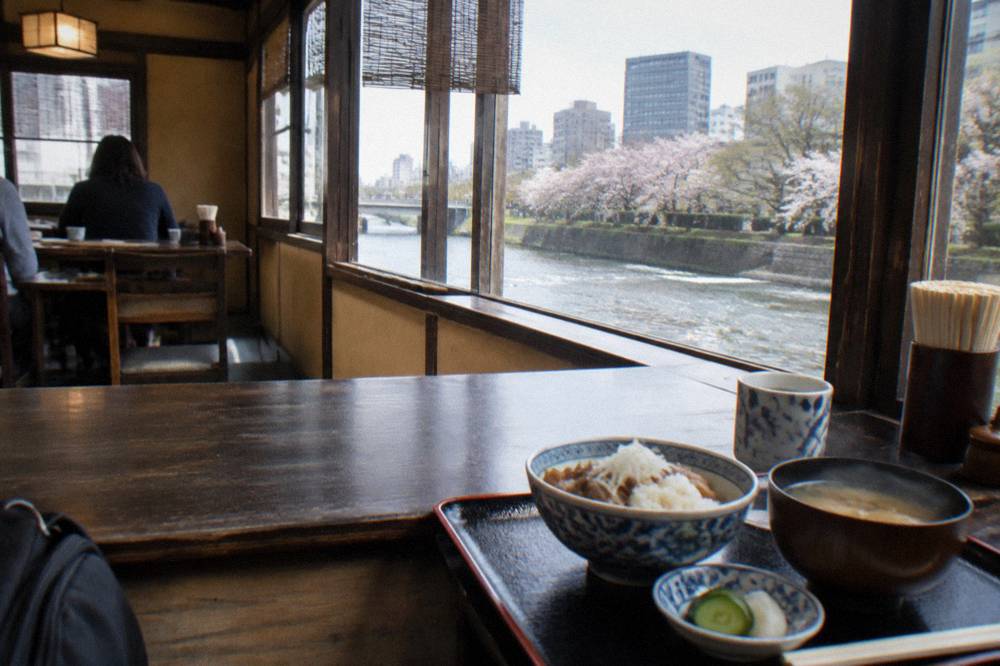
Japan Brand Collection, with japan-guide.com, offers one example of the gap: a Ginza counter where lunch runs around 9,000 yen against roughly 20,000 yen at dinner. That is a single case, not a rule. The structure behind it is classic washoku: the ichiju-sansai pattern of one soup, three sides and rice, which GO TOKYO's gourmet pages describe as the foundation of Japanese cuisine, scales naturally into a balanced, shorter midday set. A starred kitchen can honour that form at lunch without the full evening progression. The rest of the planning pages sit on Best Restaurants Tokyo.
Booking-wise, lunch also dodges part of the schedule problem. STAYGO notes that lunch slots sometimes appear after the initial release day on reservation platforms, so a dinner calendar that shows nothing may still yield a midday seat on a second look. If your heart is set on a specific name and the dinner book is closed, check lunch, check it again a few days later, and remember that many Tokyo restaurants close between services and often close on Sundays, Mondays or national holidays, a pattern documented by Japan Brand Collection in collaboration with japan-guide.com, so the midday window is narrower than it looks.
Bib Gourmand Or A Star: Which Should You Chase?
The Bib Gourmand is Michelin's value label, awarded to restaurants serving good food at moderate prices, and Tokyo's 2026 guide lists 114 of them against 160 starred venues. A star signals destination dining with the booking difficulty that follows, while a Bib signals a kitchen you can often reach on shorter notice and a smaller bill, which for most travellers means more meals and less stress across a week in the city.
The category spread tells the story. The 2026 Bib selection spans 37 culinary categories, from ramen to creative dessert courses, so the label is not a consolation prize but a map of the city's reachable excellence. Ramen makes the point sharply: the 2026 guide lists 16 Bib Gourmand ramen shops and no starred ramen at all, with new entries including Ginza Haru-chan Ramen, a shio specialist, and Teuchi Asama, a handmade-noodle soy sauce shop that opened in 2024.
For planning, the honest division of labour is this: chase one starred counter for the event of the trip, and let Bib Gourmand kitchens carry the other nights. Our what to eat in Tokyo guide covers the full spread of the city's cuisines, and the Food List's neighbourhood maps, which show what is within a 10-minute walk of where you are standing, make it easy to fit a Bib lunch into a day's sightseeing rather than building the day around it.
Which High-Difficulty Alternatives Can You Actually Book?
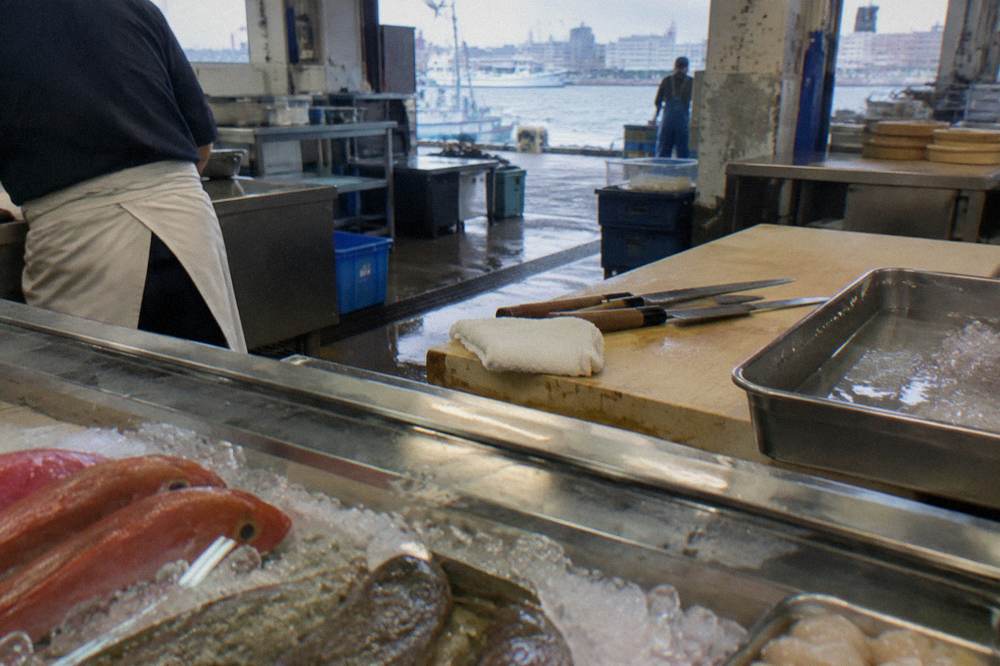
When starred counters are closed, the next tier is a set of specialist kitchens the Food List labels booking usually required or booking recommended, none of them listed with a Michelin star. Eight appear below with their Google ratings, price bands and booking labels, all from their Google listings. They deliver the counter format, the omakase structure and the same booking discipline, without needing a concierge or a raffle win.
| Restaurant | Cuisine and area | Google rating | Price level | Booking label |
|---|---|---|---|---|
| Matsue Ebisu Head Store | sushi, Shibuya | 4.8 across 1,632 reviews | expensive | booking usually required |
| Sushi Yuu | sushi, Minato / Azabu | 4.8 across 504 reviews | expensive | booking usually required |
| Mikawa Zezankyo | tempura, Koto / Fukuzumi | 4.3 across 653 reviews | very expensive | booking usually required |
| Tonkatsu Narikura | tonkatsu, Suginami | 4.2 across 609 reviews | very expensive | booking usually required |
| Shabu Shabu & Sushi Hassan Roppongi | sushi, Minato / Roppongi | 4.5 across 676 reviews | expensive | booking usually required |
| Sushi Kuni | sushi, Chuo / Tsukiji | 4.3 across 1,463 reviews | expensive | booking usually required |
| Tempura Miyashiro | tempura, Meguro | 4.6 across 305 reviews | expensive | booking recommended |
| Sushi Gen Akasaka | sushi, Minato / Akasaka | 4.8 across 614 reviews | moderate | booking recommended |
Read the order tags before you book any of them. Matsue Ebisu Head Store's record lists omakase, sea urchin and toro; Sushi Yuu's lists omakase and fatty tuna; Mikawa Zezankyo's lists kuruma prawn, matsutake mushroom and shiso sea urchin; Tonkatsu Narikura's lists a mille feuille cut, omakase and chateaubriand. Those tags are what the listings actually say to order, and at a counter with a fixed progression, knowing them in advance is the difference between ordering with intent and guessing. The omakase in Tokyo guide unpacks the format itself, and the best sushi in Tokyo guide covers the wider sushi field including the moderate and inexpensive end.
Booking behaviour across the restaurants on this site backs up the pattern. Among our 100 picks, 48 carry a booking recommended label, 45 are usually walk-in and only 7 are booking usually required, so true reservation-only kitchens are the exception, not the rule, and the table above collects most of that exception list. Price bands tilt the same way: 43 of the 100 are inexpensive and 38 moderate, against just 16 expensive and 3 very expensive, which is why a starred-or-nothing plan distorts what the city actually offers.
Can A Guided Tour Get You Counter Seats Without The Booking Fight?
A guided food tour solves the reservation problem by bundling the seats, the ordering and the neighbourhood context into one transaction with free cancellation. The omakase sushi and A5 wagyu tour runs from $130.73 per person, holds a 4.72 rating across 329 reviews, caps groups at 8 travellers and includes both meal and drinks over 3 hours. It is not a starred counter, and it does not pretend to be one.
What it does is remove every friction this page has described. No release schedule, no raffle, no cancellation penalty measured from Tokyo midnight: the listing carries free cancellation, and the maximum group size of 8 keeps the counter-scale intimacy that makes this style of eating worth doing in the first place. For a traveller who wants the premium format on a fixed itinerary, that trade is rational, and Check availability on the operator's live listing before locking your dinner plans.
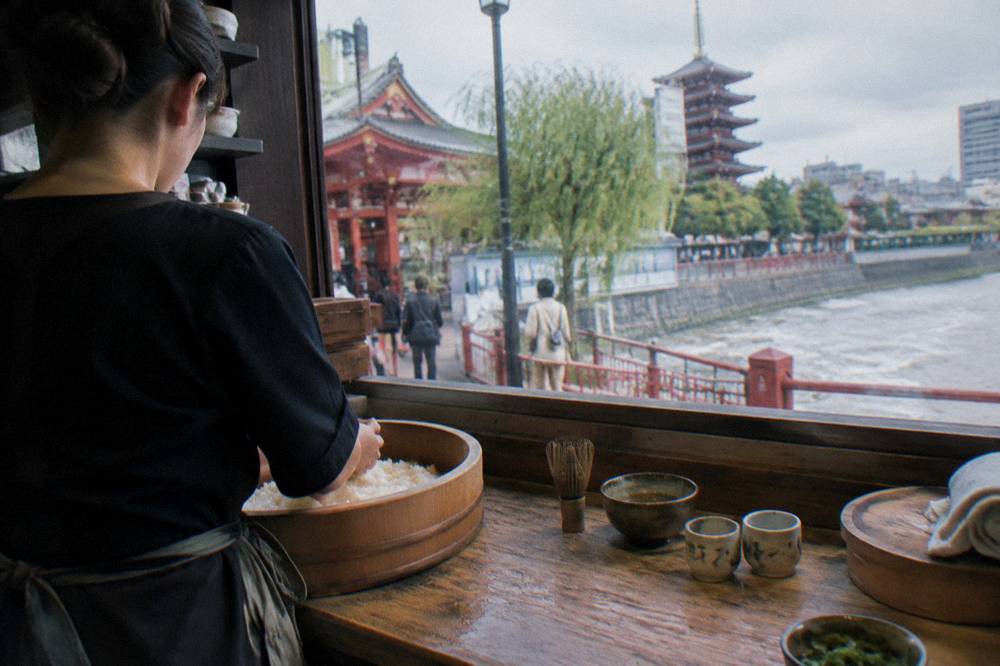
The cooking-class route works on the same logic with a different shape. The Asakusa sushi-making class with matcha and unlimited sake runs from $44.93 per person, holds a 4.94 rating across 206 reviews, lasts an hour and a half, includes meal and drinks, and carries free cancellation. You make the sushi rather than watch it made, which suits families and anyone who wants the mechanics demystified more than the mystique preserved.
A market walk is the third shape. The Tsukiji market walk with five tastings runs from $97.17 per person, holds a 4.9 rating across 3,868 reviews, caps groups at 20 and includes the tastings as the meal. It is the cheapest way to put a guide between you and the ordering screen, and Tsukiji's outer lanes reward the context: the market never relocated, as The Ondo Tokyo's history of the move explains, and its food street keeps its own rhythms separate from the Toyosu wholesale operation.
How Do You Plan A Star-Centered Eating Week?
Build the week around one hard booking and let everything else stay soft. Lock the starred or booking usually required counter one to two months out through OMAKASE, TableCheck or your concierge, and guard it with the cancellation terms in mind: SHOKU NOREN notes that high-end counters typically charge the full course price for same-day cancellations or no-shows. Fill the remaining days with booking recommended and usually walk-in kitchens grouped by neighbourhood. That structure gets you the event meal without the whole trip hinging on it.
The sequencing matters more than the specific names. Book the high-difficulty counter first, because its release schedule dictates your calendar. Add the booking recommended tier second, since those tables move a week or two out rather than two months. Leave the walk-in tier for the day itself: among our 100 picks, ramen is the most forgiving cuisine, with 10 of its 15 spots usually walk-in, while yakitori is the strictest casual category, with all 8 booking recommended, so an izakaya evening deserves a firmer plan than a noodle lunch. The izakaya and yakitori guide covers that etiquette-heavy ground in detail.
Practical guardrails finish the plan. Many restaurants close between lunch and dinner service, stop taking last orders before closing, and often close on Sundays, Mondays or national holidays, according to Japan Brand Collection with japan-guide.com, so anchor each day to one confirmed opening rather than assuming continuity. Keep payment realistic too: many small counters remain cash-only or cash plus IC card, while others take cards, and there is no uniform policy across the city. Tipping is not customary in Tokyo, and some higher-end houses instead add a 10 to 15 percent service charge, so the bill on the table is the whole bill. Anyone weighing the finer points of notes versus cards can read our piece on whether cash or card wins in Japan.
The last planning layer is choosing where to be. This page has deliberately kept the starred-versus-alternatives decision cuisine-agnostic, but the city is not: Shibuya, Shinjuku and the Ginza-Asakusa corridor each carry their own booking cultures and their own walk-in depth, and the neighbourhood guides on Best Restaurants in Tokyo break those down street by street. Start with the counter you can actually book, and let the neighbourhood carry the rest of the week.
Common Questions About Michelin Star Restaurants In Tokyo
How many Michelin star restaurants are in Tokyo?
The MICHELIN Guide Tokyo 2026 lists 160 starred restaurants: 12 three-star, 26 two-star and 122 one-star, within a 526-restaurant selection that also includes 114 Bib Gourmand entries.
How far ahead should I book a Michelin star restaurant in Tokyo?
Seats at the most sought-after counters typically open on a set schedule one to two months ahead, and availability disappears quickly, especially during cherry blossom and autumn foliage seasons.
What is the cheapest way to eat at a Michelin-starred restaurant in Tokyo?
Lunch. Lunch tasting menus at starred Tokyo restaurants typically cost a fraction of the same kitchen's dinner omakase, and midday tables are often released later and fill more slowly than dinner seats.
Can foreigners book Michelin star restaurants in Tokyo?
Yes, through English-friendly routes: OMAKASE, the guide's official reservation partner for Tokyo, Tabelog's multilingual booking and TableCheck. Phone-only venues generally need a hotel concierge or a Japanese speaker.
What happens if I cancel a high-end restaurant booking in Tokyo?
High-end and omakase restaurants commonly charge 30 to 50 percent of the course price for cancellations a few days ahead, rising to 100 percent for same-day cancellations and no-shows, charged to your registered card.
What is the difference between a Michelin star and a Bib Gourmand in Tokyo?
A star signals destination-level dining with matching booking difficulty. Bib Gourmand labels good food at moderate prices; the 2026 Tokyo guide lists 114 of them across 37 categories, including 16 ramen shops.