What To Eat In Tokyo: The Dishes To Order And Where Each One Is Done Properly
Tokyo rewards diners who order by dish rather than by restaurant. Here is each classic, what it is, where each is done properly, and how hard the table is to get.
Short answer
Start with the dishes: sushi at Shinjuku Sushi Hatsume (4.9 on Google, 2,487 reviews, booking recommended), yuzu ramen at Afuri Shibuya Dogenzaka (4.8, 3,278, usually walk-in) and tsukemen at Tsujita Ochanomizu (4.5, 3,657). Most records here are inexpensive or moderate and walk-in friendly; only a handful need booking.
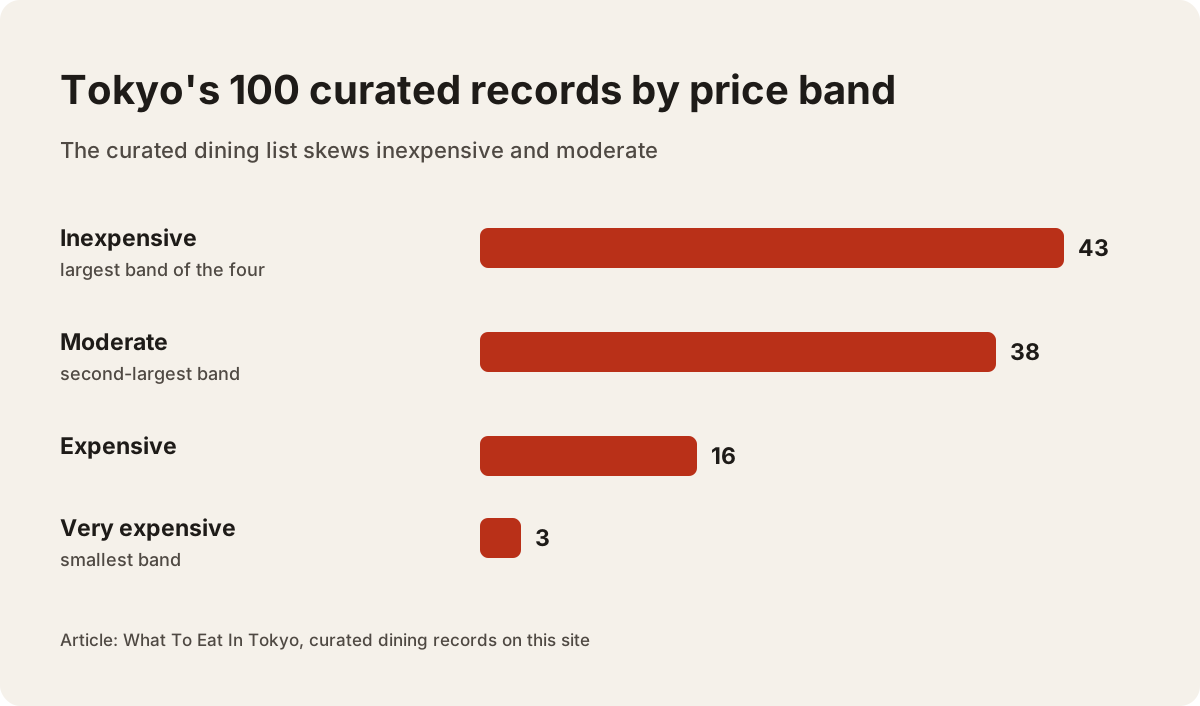
Tokyo's curated dining records on this site split into fourteen cuisines, and the spread is lopsided in a useful way: 43 of the 100 records sit in the inexpensive band and 38 in moderate, while only 16 are expensive and 3 very expensive. Almost half, 45, are labelled usually walk-in. In other words, the classic Tokyo eating list is mostly a queue at a counter, not a reservation war, and the dishes worth crossing the city for are cheap more often than not. This guide walks the eleven dishes a first-timer actually orders, names one restaurant per dish that does it properly, and flags the booking label for each.
What Are The Must-Eat Restaurants In Tokyo?
The must-eat list is a dish list before it is a restaurant list: sushi, ramen, tempura, tonkatsu, unagi, yakitori, wagyu, soba, udon, curry and dessert, one named shop for each. Among the curated 100, Google ratings run 4.2 or higher with at least 300 reviews each. Seven records need booking, 45 are walk-in, and the rest are labelled booking recommended, so the city is far more walk-up friendly than its reputation suggests.
The table below is the map for the whole article. Each dish gets one sentence on what it is and one restaurant to order it at, with its Food List booking label and price band. For every cuisine there is a deeper companion page: the best sushi in Tokyo guide covers all sixteen sushi records, the Tokyo ramen guide covers all fifteen ramen records, and the izakaya and yakitori guide handles the grilled-and-skewered side of the city.
| Dish | What it is | Where to eat it | Booking label | Price level |
|---|---|---|---|---|
| Sushi | Vinegared rice with raw or cured fish, ordered piece by piece or as omakase | Shinjuku Sushi Hatsume, 4.9 on Google across 2,487 reviews, order omakase | booking recommended | moderate |
| Ramen | Noodles in broth, shio, shoyu, miso or tonkotsu, eaten fast at a counter | Afuri Shibuya Dogenzaka, 4.8 across 3,278 reviews, order yuzu ramen | usually walk-in | inexpensive |
| Tempura | Lightly battered seafood and vegetables, fried and served one piece at a time | Tempura Kaneko Hannosuke Nihonbashi, 4.2 across 2,625 reviews | usually walk-in | inexpensive |
| Tonkatsu | Breaded pork cutlet, rosu loin or hire fillet, with cabbage and miso soup | Tonkatsu Marugo, 4.5 across 3,115 reviews, order special loin | usually walk-in | moderate |
| Unagi | Grilled eel over rice, glazed and re-grilled, a full-meal dish | Nodaiwa Azabu Iikura Honten, 4.3 across 1,679 reviews | usually walk-in | expensive |
| Yakitori | Chicken skewers over charcoal, ordered in rounds | Fukumimi Hanare, 4.9 across 2,688 reviews, order tsukune | booking recommended | moderate |
| Wagyu | Graded Japanese beef, teppanyaki or yakiniku style | Kobe Beef Dia Shibuya 1st store, 4.9 across 3,829 reviews | booking recommended | moderate |
| Soba | Buckwheat noodles, cold with dipping sauce or hot in broth | Kanda Matsuya, 4.3 across 3,768 reviews, order sesame soba | usually walk-in | inexpensive |
| Udon | Thick wheat noodles, in broth or as kamatama with egg | Udon Maruka, 4.3 across 3,730 reviews, order kamatama udon | usually walk-in | inexpensive |
| Curry | Japanese-European style curry rice, thick and mild | Curry Bondy, 4.3 across 5,377 reviews, order beef curry | usually walk-in | expensive |
| Dessert | Fried and baked sweets, often eaten standing near the shop | Age.3 ASAKUSA, 4.8 across 4,352 reviews, order fried sandwich | usually walk-in | inexpensive |
If you would rather browse by neighbourhood, Google rating or reservation difficulty than by dish, our own guide, The Tokyo Food List, holds 980+ Tokyo restaurants with what to order, booking links and map pins for each, and it is made to open on a phone and pick by neighbourhood. For more restaurant picks beyond this table, The Tokyo Food List adds 980+ places sorted by cuisine, Google ratings and price ranges.
Tokyo's 100 curated records by price band
Sushi In Tokyo: What To Order And Where
Order omakase at Shinjuku Sushi Hatsume, which holds 4.9 on Google across 2,487 reviews, sits in the moderate price band and carries the booking recommended label, so reserve rather than walk in. Omakase hands the sequence to the chef, which is the standard way to eat at a proper counter. Among the sixteen sushi records curated here, four are usually walk-in and four need booking, so the cuisine spans every commitment level.
Sushi in Tokyo splits three ways: conveyor and standing shops for speed, casual counters for a set, and full omakase dinners where the chef decides each piece in order. Lunch at the same counter is typically far cheaper than dinner for the same quality of fish, which makes a midday counter visit the value play. The deeper omakase in Tokyo guide explains the format, the fees and the booking mechanics in full.
Hatsume is the headline restaurant for the dish-first map, but the cuisine is broader than one address. Sushi Mon Shinjuku, at 4.7 across 1,552 reviews, is inexpensive and usually walk-in, an entirely different commitment. R/Q in the moderate band at 4.9 across 680 reviews is also labelled usually walk-in. Booking labels here describe what usually happens rather than a fixed policy, so it pays to check ahead.
Ramen In Tokyo: What To Order And Where
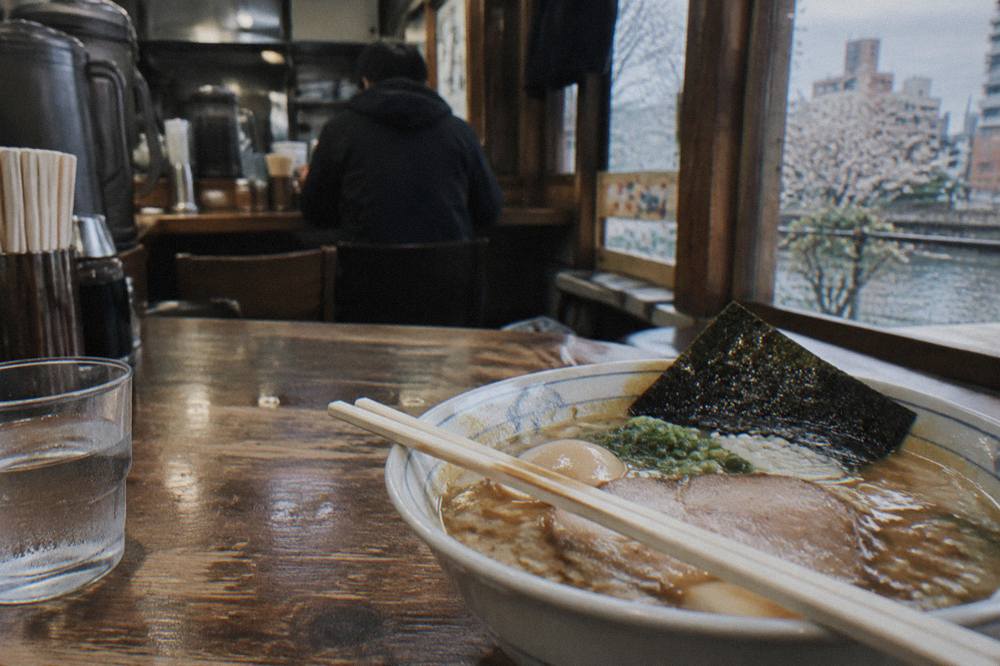
Order yuzu ramen at Afuri Shibuya Dogenzaka, 4.8 on Google across 3,278 reviews, inexpensive and usually walk-in, or spicy miso at Jikasei MENSHO, 4.8 across 4,480 reviews, also walk-in. At most Tokyo ramen shops you buy a meal ticket from a vending machine by the entrance and hand it to staff when seated; turnover is fast, so do not linger after the bowl is finished.
The ramen records on this site include eleven inexpensive and three moderate bowls plus one very expensive outlier, which tells you the dish is fundamentally a counter food. Afuri's own site lists its signature yuzu shio ramen, and the shop also carries shio ramen and char siew rice on its order tags. Jikasei MENSHO's record lists spicy miso ramen, vegan tantanmen and truffle ramen, a spread that covers most dietary angles in one kitchen. Tsujita Ochanomizu, 4.5 across 3,657 reviews in the moderate band, is the tsukemen entry: noodles for dipping in a concentrated broth, with sudachi and togarashi on the order tags.
| Ramen record | Ward | Google rating | Reviews | Order tags | Booking label |
|---|---|---|---|---|---|
| Afuri Shibuya Dogenzaka | Shibuya | 4.8 | 3,278 | yuzu ramen, shio ramen, char siew rice | usually walk-in |
| Jikasei MENSHO | Shibuya | 4.8 | 4,480 | spicy miso ramen, vegan tantanmen, truffle ramen | usually walk-in |
| Tsujita Ochanomizu | Chiyoda / Kanda | 4.5 | 3,657 | tsukemen, sudachi, togarashi | usually walk-in |
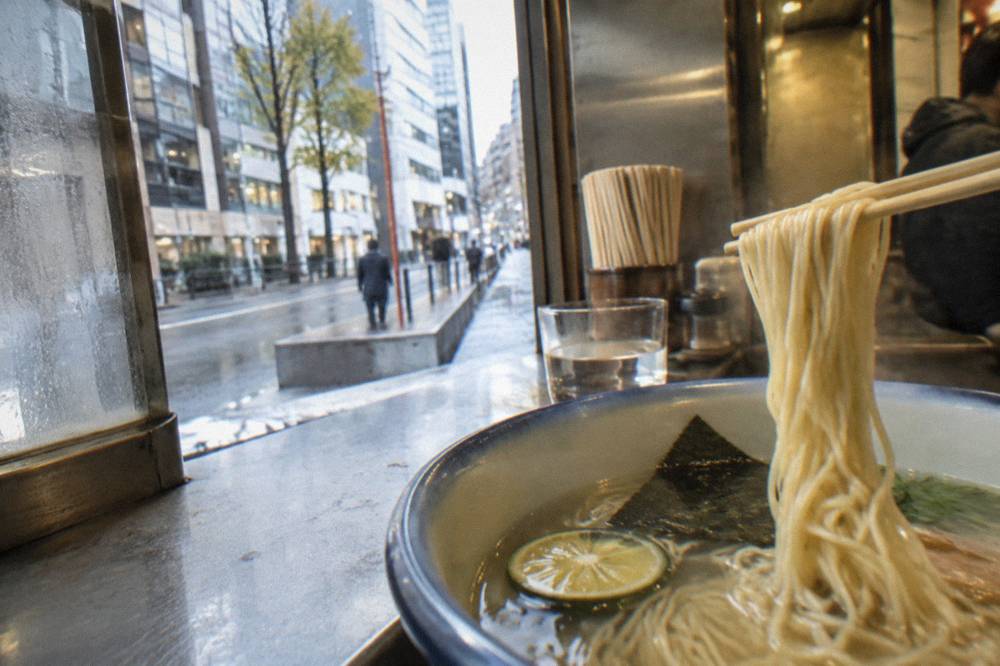
Many small ramen shops remain cash-only or cash plus IC card, though others take cards and there is no uniform policy, so carry some cash for counter queues. The Afuri official site lists locations and the signature bowls if you want to compare branches before you go.
Tempura And Tonkatsu In Tokyo: The Two Fried Classics
Order the tendon at Tempura Kaneko Hannosuke Nihonbashi, 4.2 on Google across 2,625 reviews, inexpensive and usually walk-in, and the special loin at Tonkatsu Marugo, 4.5 across 3,115 reviews, moderate and walk-in. Both are fried foods but they are different meals: tempura is sequenced piece by piece, tonkatsu is one cutlet with cabbage, rice and miso soup.
At dedicated tempura counters the chef fries and serves pieces one at a time, so each piece must be eaten immediately for peak crispness, and the progression typically starts with lighter items such as white fish or shrimp and moves to richer ones like anago or kakiage. Kaneko Hannosuke's order tags list takuan and maitake, the pickle and the mushroom that anchor a tendon bowl. The shop's own page carries the current queue and menu detail. Tonkatsu is the other fried classic and the choice is the cut: diners choose between rosu, the pork loin with a visible strip of fat for a juicier bite, and hire, the leaner tender fillet. Marugo's tags list special loin, fried pork cutlet and red miso soup, so the shop leans loin.
| Fried classic | Record | Google rating | Reviews | Order tags | Booking label |
|---|---|---|---|---|---|
| Tempura | Tempura Kaneko Hannosuke Nihonbashi | 4.2 | 2,625 | takuan, maitake | usually walk-in |
| Tonkatsu | Tonkatsu Marugo | 4.5 | 3,115 | special loin, fried pork cutlet, red miso soup | usually walk-in |
Both records carry the usually walk-in label, so neither belongs on a reservation list. That makes this pairing the natural filler between booked dinners: walk up, queue briefly, eat, move on.
Unagi, Soba And Udon In Tokyo: The Noodle And Eel Course
Order eel over rice at Nodaiwa Azabu Iikura Honten, 4.3 on Google across 1,679 reviews, expensive and usually walk-in despite the price band; sesame soba at Kanda Matsuya, 4.3 across 3,768 reviews, inexpensive; and kamatama udon at Udon Maruka, 4.3 across 3,730 reviews, inexpensive. The eel dish is the splurge, the noodle shops are the budget anchors.
Unagi is grilled eel over rice, brushed with sauce and re-grilled, and it is the one dish in this group where prices are moving: wholesale eel prices dropped about 40 percent year on year after strong glass eel catches, and industry voices quoted by News On Japan expected restaurant prices to follow from autumn onward. Nodaiwa's order tags list eel over rice, grilled eel without sauce and nikogori, so both sauced and plain styles are on the table. Soba and udon are the fast end of Tokyo eating: standing shops near stations serve a plain bowl of kake soba at 430 to 450 yen at chains like Fuji Soba, per tokyo.how, with meals typically finished in minutes. Kanda Matsuya's tags list sesame soba and yuzu; Udon Maruka's list toriten and kamatama udon, the hot-noodle-in-egg-butter bowl.
| Dish | Record | Ward | Google rating | Reviews | Price level | Booking label |
|---|---|---|---|---|---|---|
| Unagi | Nodaiwa Azabu Iikura Honten | Minato / Azabu | 4.3 | 1,679 | expensive | usually walk-in |
| Soba | Kanda Matsuya | Chiyoda / Kanda | 4.3 | 3,768 | inexpensive | usually walk-in |
| Udon | Udon Maruka | Chiyoda / Kanda | 4.3 | 3,730 | inexpensive | usually walk-in |
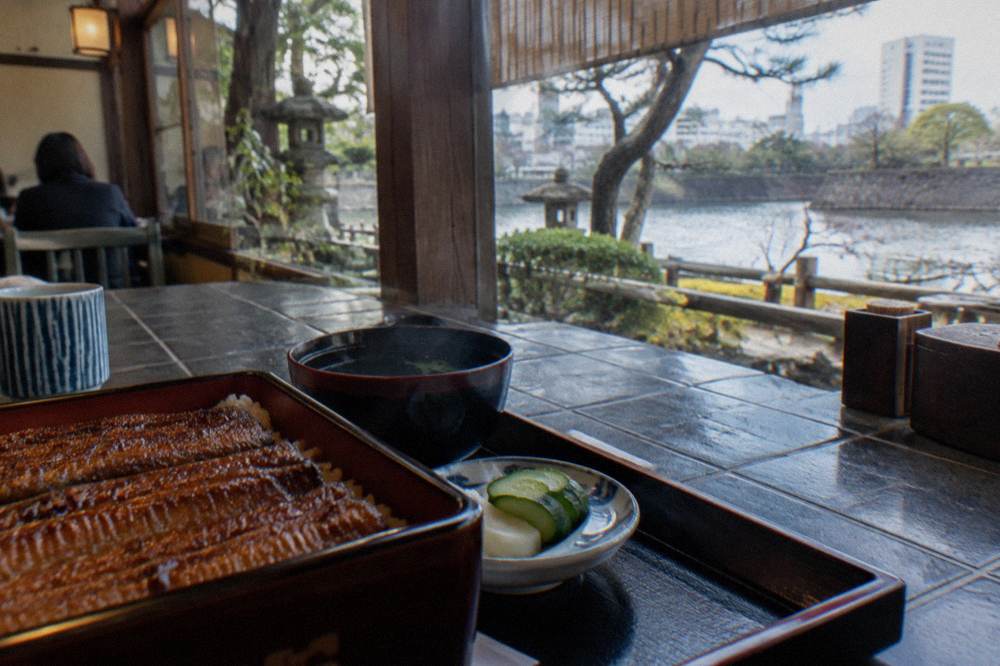
Note that all three carry the walk-in label even though one is expensive. Booking difficulty in Tokyo tracks kitchen format, not price: a counter that turns tables quickly can stay walk-up even at unagi prices, while a cheap twelve-seat ramen shop on a reservation system cannot.
Yakitori, Wagyu And Izakaya Eating In Tokyo
Order skewers and tsukune at Fukumimi Hanare, 4.9 on Google across 2,688 reviews, moderate with booking recommended, and Kobe beef teppanyaki at Kobe Beef Dia Shibuya 1st store, 4.9 across 3,829 reviews, moderate with booking recommended. Kushikatsu Tanaka Higashi-Ginza, 4.8 across 4,494 reviews, is the inexpensive izakaya fallback. These are the two booked meals of the dish map.
Izakaya are where the otoshi rule bites: a small appetizer arrives automatically at most izakaya and works as a per-person table charge, typically a few hundred yen, sometimes up to around a thousand at nicer places. It is tied to the seat, so treat it as part of the cover rather than an error on the bill. Yakitori itself is straightforward once seated: skewers ordered in rounds, chicken meatball tsukune among them, and omakase at a yakitori counter simply hands the sequence to the kitchen. Wagyu is the other booked splurge, and grading matters: A5 is the top of the Japan Meat Grading Association scale, A for yield and 5 for quality, though yield grade is a measure of carcass efficiency, not eating quality.
| Dish | Record | Ward | Google rating | Reviews | Order tags | Booking label |
|---|---|---|---|---|---|---|
| Yakitori | Fukumimi Hanare | Shinjuku | 4.9 | 2,688 | skewers, chicken meatball, tsukune | booking recommended |
| Wagyu | Kobe Beef Dia Shibuya 1st store | Shibuya | 4.9 | 3,829 | kobe beef, teppanyaki | booking recommended |
| Izakaya | Kushikatsu Tanaka Higashi-Ginza Store | Chuo / Ginza | 4.8 | 4,494 | takoyaki, kushikatsu | booking recommended |
If you want the izakaya and yakitori side of the city walked for you, the Shinjuku Local Eateries Walk is a 3-hour guided route through the neighbourhood's small counters, capped at 12 travellers, with a meal and drinks included and free cancellation; it runs from $84.21 per person and holds a 4.9 rating across 10,498 reviews. A guided first evening is a reasonable way to see how Omoide Yokocho's alley rules work, since the merchants association there notes some shops set a 90-minute limit and require one drink and one food order per customer on entry.
For a deeper run at the grilled side of the city, the izakaya and yakitori in Tokyo guide covers the full record set, and the wagyu and teppanyaki guide explains the grading system behind the beef.
Curry And Desserts In Tokyo: The Sweet And Mild End
Order beef curry at Curry Bondy, 4.3 on Google across 5,377 reviews, the most-reviewed record in this article, and a fried sandwich at Age.3 ASAKUSA, 4.8 across 4,352 reviews, inexpensive and walk-in. Bondy is curiously labelled expensive yet usually walk-in, another sign that price and booking difficulty do not track each other. Tokyo curry is European-style: thick, mild, dark, nothing like Indian or Thai.
Curry Bondy's order tags list beef curry, european-style curry and flan, a pudding finish that says everything about the genre's old-school European roots. Age.3 in Asakusa is the dessert stop: its tags list sandwiches, creme brulee and the fried sandwich, which is exactly what it sounds like and is eaten standing, often within a minute of the fryer. Among the curated 100, all three dessert records are inexpensive, and three of the five dessert and breakfast records combined are usually walk-in, so this closing course costs almost nothing.
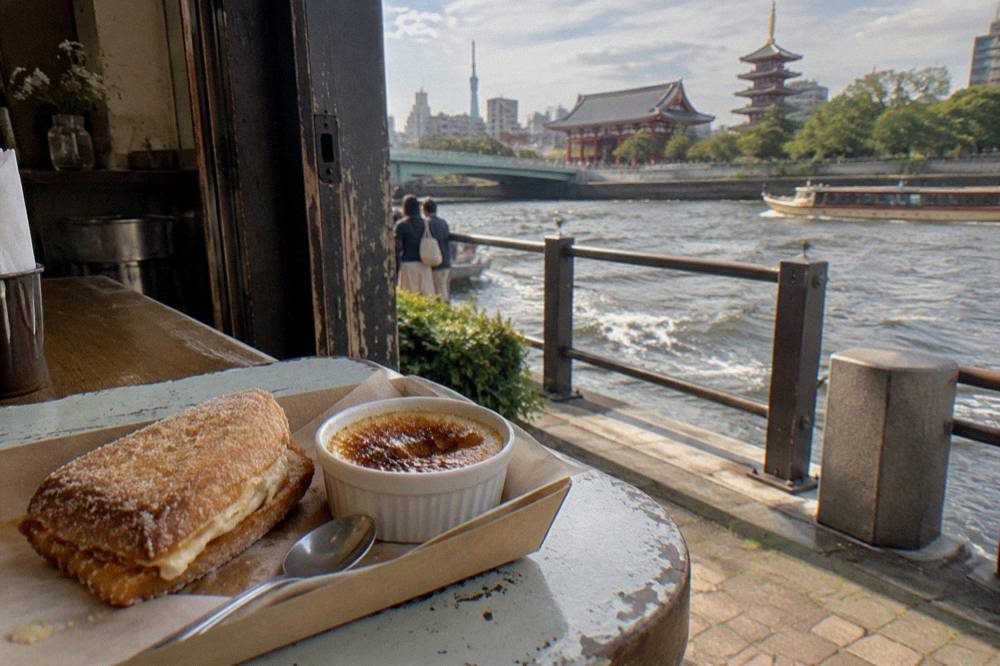
A note on tax at the counter: dine-in restaurant meals incur 10 percent consumption tax while identical takeout is taxed at the reduced 8 percent rate, as NHK reports, and convenience store items switch the same way depending on whether you use the eat-in area. For a fried sandwich eaten standing in the street, the takeaway rate is the one that applies.
How To Plan Eating Across Tokyo In One Trip
Group dishes by booking label, not by neighbourhood: reserve the booking-recommended records (sushi omakase, yakitori, wagyu, the Ginza izakaya), and fill the gaps with the 45 walk-in counters. Many Tokyo restaurants close between lunch and dinner service and often close on Sundays, Mondays or national holidays, so check each record's days before building a route. Plan one booked meal a day and let walk-ins carry the rest.
The booking split across the curated 100 is 45 usually walk-in, 48 booking recommended and 7 booking usually required, so the average day in Tokyo is more walk-up than reservation. Booking difficulty also follows the cuisine: every udon and coffee record is walk-in, as are seven of the eight tonkatsu records, while yakitori and wagyu are almost entirely booking recommended. If the decision you are making is which tables to fight for, our own guide, The Tokyo Food List, sorts its 980+ records by reservation difficulty and includes booking links, so you can see at a glance which dishes need a plan.
| Booking label | Records | Cuisines where it dominates | What it means for planning |
|---|---|---|---|
| Usually walk-in | 45 | ramen, tonkatsu, udon, soba, unagi, dessert | Turn up, queue, eat |
| Booking recommended | 48 | yakitori, wagyu, izakaya, sushi | Reserve days ahead, especially weekends |
| Booking usually required | 7 | four sushi counters plus one tempura, one tonkatsu and one ramen record | Book well ahead or skip |
One efficient first morning is Tsukiji's outer market: the lanes never relocated when the wholesale market moved to Toyosu, and per GO TOKYO the market is closed on Wednesdays, Sundays and national holidays, with the 9:00 to 13:00 window the busiest. A guided version, the Tsukiji Market tour with 5 tastings, is a 3-hour walk capped at 20 travellers with tastings and a meal included, free cancellation, from $97.17 per person; it holds 4.9 across 3,868 reviews.
Beyond the dish map, the rest of Best Restaurants Tokyo breaks the same 100-record set down by neighbourhood, including dedicated pages for Shibuya, Shinjuku, and Ginza and Asakusa, so once you know which dishes you want you can find the nearest record doing it properly.
For evenings when you want several dishes and drinks in one seated go, three guided options cover the spread: the Shinjuku Local Eateries Walk, the Tsukiji Market tastings walk, and a Shinjuku bar hop with a free-flow full dinner through the Golden Gai area, capped at 7 travellers, from $109.35 per person with a 4.9 rating across 4,086 reviews. Each includes a meal, each carries free cancellation, and none asks you to choose a single dish.
Common Questions About What To Eat In Tokyo
What are the must-eat restaurants in Tokyo?
Order by dish: omakase sushi at Shinjuku Sushi Hatsume (4.9 on Google, 2,487 reviews, booking recommended), yuzu ramen at Afuri Shibuya Dogenzaka (4.8, 3,278, walk-in), tsukemen at Tsujita Ochanomizu (4.5, 3,657), tonkatsu at Tonkatsu Marugo (4.5, 3,115), yakitori at Fukumimi Hanare (4.9, 2,688) and wagyu at Kobe Beef Dia Shibuya 1st store (4.9, 3,829). Most of these are inexpensive or moderate; only the wagyu and yakitori stops need a reservation.
What should a first-timer eat in Tokyo?
Work through the dish map: one sushi counter, one ramen counter, one fried classic (tempura or tonkatsu), one yakitori or izakaya evening, and a sweet stop at Age.3 ASAKUSA. Ramen and udon counters are usually walk-in and inexpensive, so they absorb the gaps between booked meals.
Do I need reservations to eat well in Tokyo?
Mostly no. Among the curated 100 records, 45 are labelled usually walk-in and only 7 booking usually required. Reserve for omakase sushi, yakitori counters and wagyu teppanyaki; the rest of the dish map is queue-and-eat.
How do I order at a ramen shop in Tokyo?
At most Tokyo ramen shops you buy a meal ticket from a vending machine by the entrance, hand it to staff when seated, and eat quickly as turnover is fast. Many small shops remain cash-only or cash plus IC card, so carry cash for the machine.
What is the otoshi charge at an izakaya?
Otoshi is a small appetizer served automatically at most izakaya and it works as a per-person table charge, typically a few hundred yen, sometimes up to around a thousand at nicer places. It is tied to the seat and is standard practice, not an error.
Is lunch cheaper than dinner in Tokyo?
Typically yes, and often dramatically so at sushi counters, where a lunch set at the same counter can cost a fraction of the dinner omakase. Booking windows also ease at lunch, so midday is the value play for booked-up kitchens.