How Much Is A Meal In A Restaurant In Tokyo?
A price-tier guide to Tokyo restaurant costs using Food List price levels, tax, service charges and lunch-versus-dinner differences, with named restaurants at every band.
How Much Is A Meal In A Restaurant In Tokyo?
A Tokyo restaurant meal falls into one of four Food List price bands: inexpensive, moderate, expensive or very expensive. Among our 100 picks, 43 are inexpensive, 38 moderate, 16 expensive and 3 very expensive, so most meals sit in the lower two bands. The final bill then moves with three add-ons: 10% consumption tax at the table, occasional service charges, and the small otoshi appetizer at izakaya. Even within those lower price bands you can still reach fine dining, and the guide to cheap Michelin-starred meals in Tokyo explains how lunch menus make it possible.
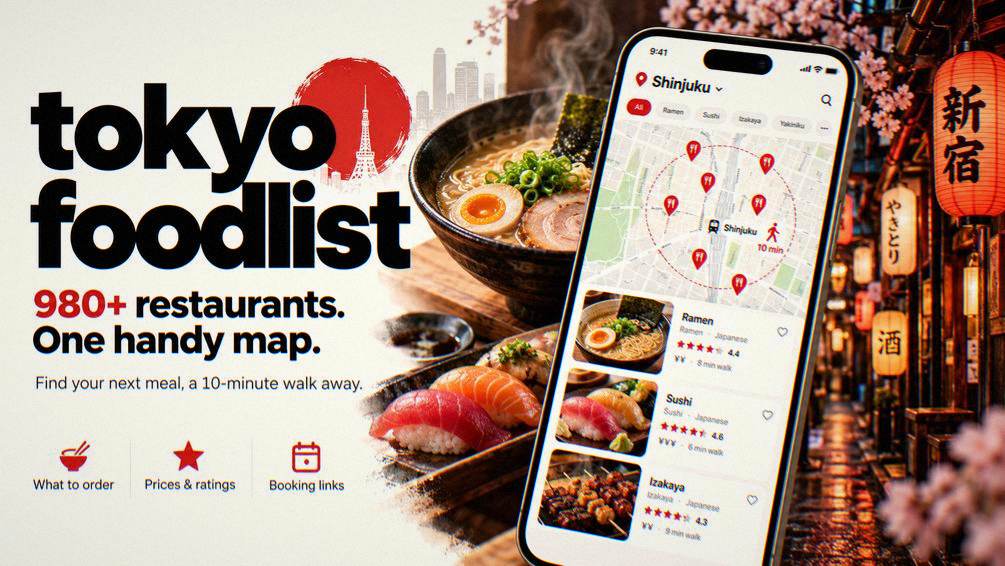
The honest answer is that Tokyo is cheaper to eat well in than almost any other capital at this quality level, but the price spread is enormous. A bowl of ramen at Jikasei MENSHO in Shibuya, 4.8 on Google across 4,480 reviews, sits in the inexpensive band and is labelled usually walk-in, so there is no booking friction either. At the other end, Matsue Ebisu Head Store in Ebisu, 4.8 on Google across 1,632 reviews, is labelled expensive with booking usually required, and its omakase, sea urchin and toro order tags tell you exactly what that band buys. For more restaurant picks beyond this table, The Tokyo Food List adds 980+ places sorted by cuisine, Google ratings and price ranges.
What trips visitors up is not the headline price, it is the structure around it. Tax differs between eating in and taking out, some counters add charges that never appear on the menu, and lunch at the same restaurant can cost a fraction of dinner. This guide walks through the four price bands using the 100 restaurants on this site, then the add-ons, then the cheapest ways into each cuisine. For sorting any of these restaurants by price band, reservation difficulty and what to order in one place, The Tokyo Food List holds 980+ Tokyo restaurants with booking links and map pins, made to open on a phone. If you want to see how the famous picks compare on price, the guide to Anthony Bourdain's favorite Tokyo restaurants tracks where he actually ate and what booking those counters involves today.
What The Price Levels Mean On A Tokyo Menu
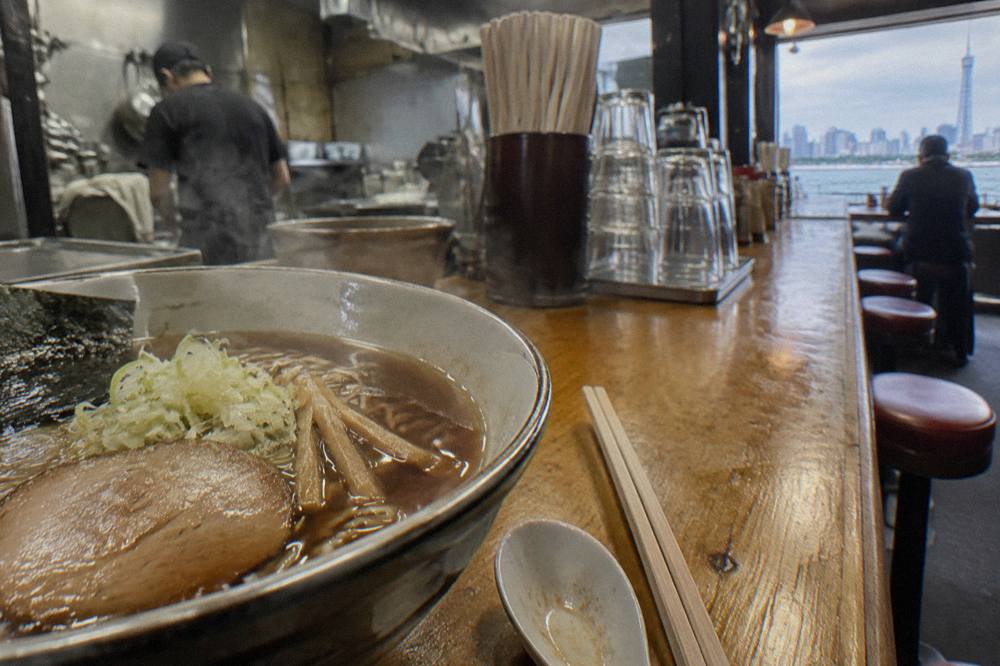
The Food List sorts restaurants into four price bands, and among our 100 picks the distribution is: 43 inexpensive, 38 moderate, 16 expensive and 3 very expensive. Ramen skews cheapest, 11 of its 15 restaurants inexpensive. Sushi appears in every band, 4 inexpensive, 8 moderate and 4 expensive. Unagi is different: all four of its restaurants sit in the expensive band, a pattern no other cuisine matches.
Those bands are a planning tool, not a currency conversion. An inexpensive band means counter food: ramen, standing soba, kushikatsu, convenience-adjacent coffee counters. Moderate means a sit-down meal with table service, which covers most tonkatsu, yakitori and mid-range sushi. Expensive means omakase counters and wagyu teppanyaki, where the meal is a booked event. Very expensive is a thin slice, 3 of the 100, for special-occasion dining. Once you know what each band costs, the Tokyo eating guide that flags what to book ahead helps you decide which meals deserve the splurge.
The table below shows the full spread by cuisine across our 100 picks.
| Cuisine | Inexpensive | Moderate | Expensive | Very expensive | Total |
|---|---|---|---|---|---|
| sushi | 4 | 8 | 4 | 0 | 16 |
| ramen | 11 | 3 | 0 | 1 | 15 |
| izakaya | 8 | 3 | 1 | 0 | 12 |
| wagyu | 3 | 7 | 0 | 0 | 10 |
| tempura | 3 | 2 | 2 | 1 | 8 |
| tonkatsu | 2 | 5 | 0 | 1 | 8 |
| yakitori | 3 | 5 | 0 | 0 | 8 |
| curry | 1 | 2 | 1 | 0 | 4 |
| soba | 1 | 0 | 3 | 0 | 4 |
| unagi | 0 | 0 | 4 | 0 | 4 |
Reading it practically: if your budget says inexpensive, ramen and izakaya give you the most choice by far, 19 inexpensive records between them, of which 12 are usually walk-in. If you can stretch to moderate, the whole mid-market opens up, including wagyu, since 7 of the 10 wagyu picks among our 100 picks are moderate rather than expensive. Kobe Beef Dia Shibuya 1st store, 4.9 on Google across 3,829 reviews, is a moderate-band wagyu record with booking recommended, which surprises people expecting wagyu to always mean the top band. Its order tags, kobe beef and teppanyaki, sit at the centre of what that band buys.
Sushi is the cuisine where the band matters most for your wallet. Shinjuku Sushi Hatsume at 4.9 across 2,487 reviews is moderate with booking recommended, while Matsue Ebisu Head Store is expensive with booking usually required. Same cuisine, same city, roughly a band apart, and the booking label moves with the price: the pricier the counter, the more the Food List labels it as needing a reservation. If you are weighing bands against each other for a whole trip, the sushi deep dive in best sushi in Tokyo breaks the 16 records down individually.
How Tax, Service Charges And Otoshi Add To The Bill
Three add-ons move a Tokyo bill beyond the menu price. Dine-in meals carry 10% consumption tax while identical takeaway is taxed at 8%, so the same dish can cost differently by where you eat it. Tipping is not customary and staff may return left money. At izakaya, a small otoshi appetizer typically works as a per-person table charge, and some higher-end restaurants add a 10-15% service charge instead.
The tax split is the one almost nobody knows in advance. Japan's consumption tax runs 10% for eating in and a reduced 8% for takeaway, and menus must show tax-included prices, so the sticker is honest, but the register treats the same lunch box differently depending on whether you sit down or walk out. According to tripguide.tokyo's cheap-eats guide, a regular gyudon at Yoshinoya costs 498 yen to eat in and 489 yen to take away, and the gap is exactly that tax differential. Convenience store food follows the same rule: 8% taken outside, 10% if you use the store's eat-in corner.
Tipping, by contrast, is simple: do not. As japan-guide.com's etiquette page explains, tipping is not customary in Japanese restaurants and staff may return a tip left behind, while some higher-end and hotel restaurants add an automatic service charge of 10-15% instead. That service charge, when it exists, appears on the bill, not as an expectation of you.
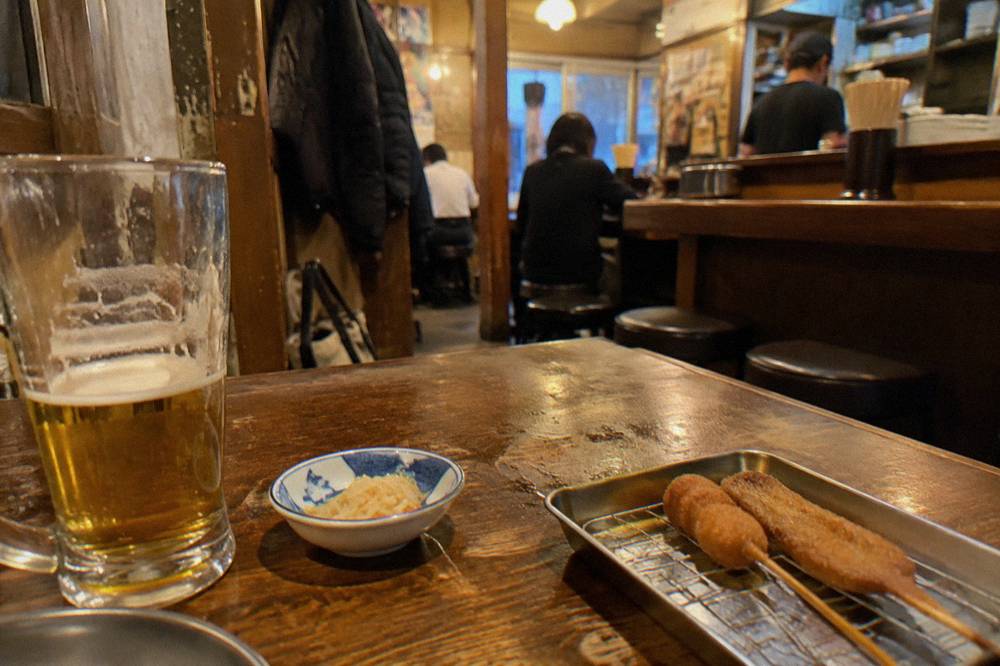
The otoshi is the subtle one. At most izakaya a small appetizer arrives without being ordered, and as tokyo.how's guide to restaurant charges explains, it typically works as a per-person table charge in the range of a few hundred yen, up to around 1,000 yen at nicer places. You can sometimes decline it politely before eating, but often it is tied to the seat. At a chain like Kushikatsu Tanaka Higashi-Ginza Store, 4.8 on Google across 4,494 reviews and inexpensive with booking recommended, the kushikatsu and takoyaki order tags mean the food itself stays cheap, so any table charge is a small share of the bill. At a tiny counter it can be proportionally larger, so it is worth glancing at what lands before assuming it was free.
Why Lunch Costs Less Than Dinner In Tokyo
Lunch at the same Tokyo counter typically costs far less than dinner: at one Ginza sushi counter, about 9,000 yen at lunch versus about 20,000 yen at dinner for the same style of omakase, per Japan Brand Collection with japan-guide.com. Many restaurants also close between services and take last orders before closing, so the lunch window is both cheaper and narrower than visitors expect.
That lunch-dinner gap is the single biggest lever on a Tokyo food budget. The kitchen, the chef and the fish are the same; the price is not. It is why the moderate band can behave like the inexpensive band if you shift your main meal earlier. Tonkatsu Marugo in Kanda, 4.5 on Google across 3,115 reviews, is moderate with usually walk-in, and its special loin, fried pork cutlet and Red Miso Soup order tags make it a classic set-meal lunch rather than a dinner event.
The set-meal format, teishoku, is part of why lunch is structured this way. As japanmanners.com explains, teishoku arrives all at once on a tray with rice, soup, main and sides, and diners move between components rather than finishing each in sequence. It is a complete, balanced plate built for midday turnover, and GO TOKYO's washoku primer traces the format to ichiju-sansai, one soup and three sides plus rice, the foundation of Japanese cuisine.
A second reason to plan around lunch: closing patterns. Many Tokyo restaurants close between lunch and dinner service, stop taking last orders before the stated closing time, and often close on Sundays, Mondays or national holidays, a pattern Japan Brand Collection, in collaboration with japan-guide.com, notes across individual venue listings. Turning up at 15:00 hoping for a cheap sushi lunch can mean finding the shutters down. Booking behaviour shifts too: among our 100 picks, the Google listings label 45 usually walk-in, 48 booking recommended and only 7 booking usually required, and all seven of those sit in the expensive or very expensive bands. The question of which restaurants in Tokyo require reservations covers that thin top slice in detail.
Inexpensive Eats That Still Rate Highly On Google
The inexpensive band is not a compromise tier in Tokyo. Restaurants like Jikasei MENSHO, Tempura Kaneko Hannosuke Nihonbashi and UMAIR HALAL WAGYU RAMEN UENO-PARK all sit in that band, and the Google listings label most of them usually walk-in. High Google ratings and low price bands overlap constantly across the restaurants on this site.
That overlap is Tokyo's defining food trait. In many cities the best-rated restaurants sit in the top price band; here, the single highest-rated of our 100 picks with large review pools, Shinjuku-tei Yotsuya Halal Wagyu Ramen at 4.9 across 3,552 Google reviews, is inexpensive with booking recommended. Counter formats keep overheads low, turnover fast and quality transparent, because the kitchen is two metres from your bowl.
| Restaurant | Cuisine | Google rating | Reviews | Price level | Booking label |
|---|---|---|---|---|---|
| Jikasei MENSHO | ramen | 4.8 | 4,480 | inexpensive | usually walk-in |
| Tempura Kaneko Hannosuke Nihonbashi | tempura | 4.2 | 2,625 | inexpensive | usually walk-in |
| The Coffee Counter Tokyo | coffee | 4.9 | 620 | inexpensive | usually walk-in |
| Kushikatsu Tanaka Higashi-Ginza Store | izakaya | 4.8 | 4,494 | inexpensive | booking recommended |
| UMAIR HALAL WAGYU RAMEN UENO-PARK | ramen | 5.0 | 486 | inexpensive | usually walk-in |
Each of these fixes a full meal inside the lowest band. Jikasei MENSHO's order tags, spicy miso ramen, vegan tantanmen and truffle ramen, span three completely different bowls at the same counter. Tempura Kaneko Hannosuke Nihonbashi, whose tags include takuan and maitake, is the famous queue-style tendon counter in Nihonbashi, and its usually walk-in label means the cost is time rather than a booking. The Coffee Counter Tokyo in Kanda, 4.9 across 620 reviews and labelled as tending to draw a local crowd, serves panini, toasties and banana bread, which makes it an inexpensive breakfast or lunch stop rather than a coffee splurge.
Note what the booking labels in that table tell you about cost planning: inexpensive usually pairs with usually walk-in, so your spend is flexible day to day. When the inexpensive band does say booking recommended, as at Kushikatsu Tanaka Higashi-Ginza or GYUMON Ueno, it reflects a busy location rather than a formal dining ritual. For anyone mapping whole days around the cheapest strong options, the cheap eats in Tokyo guide works through the budget end of the restaurants on this site, cuisine by cuisine, and The Tokyo Food List lets you filter its 980+ restaurants by price range and see what is within a 10-minute walk of wherever you are standing.
When A Guided Food Walk Makes Sense For The Budget
A food tour prices your evening in advance, which suits visitors who would otherwise overspend on unfamiliar menus. The Shinjuku Local Eateries Walk runs from $84.21 per person for 3 hours, 4.9 across 10,498 reviews, with a meal and drinks included and free cancellation. The Tsukiji Market walk with 5 tastings runs from $97.17, 4.9 across 3,868 reviews, meal included.
Whether that is "worth it" depends on what the fixed price replaces. In Shinjuku's alley dining, per-shop table charges and cover charges add up in ways a first-time visitor cannot predict: the Golden Gai guides on izakayamanual note that most bars there charge a seat charge of roughly 500 to 1,500 yen per person, often posted on the door, and the Omoide Yokocho merchants association states that some shops set a 90-minute time limit per group and require one drink and one food order per person on entry. A guided walk that includes the meal and drinks converts all of that unpredictability into one number known before you fly.
The market-side option works the same arithmetic differently. Tsukiji's outer lanes reward grazing across many stalls rather than one sit-down meal, and a five-tasting structure guarantees you actually find the strong stalls instead of gambling on signage. Context matters for timing too: GO TOKYO's official page notes the outer market is closed on Wednesdays, Sundays and national holidays, with most stores busiest between 9:00 and 13:00, so a morning walk fits the market's own rhythm. Both tours carry free cancellation, which keeps the booking low-risk while your itinerary settles.
Against the price bands above, a sub-$100 food walk sits around the moderate band for a full evening, with the research already done. Against the inexpensive band it is a step up, and the trade is knowledge: you leave knowing which counter formats, charges and ordering systems suit you, which is exactly the information the rest of this guide tries to hand you in advance. For travellers who prefer to fix one structured meal and self-direct the rest, the mix of a single tour plus walk-in ramen and kushikatsu counters is the most common pattern the price data supports.
Budgeting Across A Whole Trip By Band
A workable pattern: inexpensive band for one or two meals a day, moderate for the feature meal, and one expensive booking for the trip. Of our 100 picks, 43 sit in the inexpensive band and 38 in the moderate band, which leaves plenty of variety without drifting out of budget. Only 7 carry the booking usually required label, so rigid reservations barely touch a budget itinerary.
The expensive booking is worth protecting precisely because it is rare. Sixteen expensive and three very expensive records among the 100 means the top bands are a deliberate choice, not a default, and their booking labels show it: Matsue Ebisu Head Store, Sushi Kuni and Sushi Yuu all pair expensive with booking usually required. Verification matters at this end too. When a figure or a fee is unclear on a listing, the price is on the listing, not in a guide's guess, and high-end counters commonly charge 30 to 50% of the course price for cancellations a few days ahead, rising to 100% for same-day no-shows, as SHOKU NOREN's cancellation guide explains.
Mid-band planning is where most of a trip actually lives, and the moderate band is broad enough to hold both Tonkatsu Marugo's set meals and Shinjuku Sushi Hatsume's omakase at 4.9 across 2,487 reviews. That breadth is why this site, Best Restaurants Tokyo, sorts records by band and booking label rather than by cuisine alone: two moderate restaurants can behave completely differently at the register. The booking guidance in how to make reservations in Japan covers the platforms and concierge routes for the few slots that need them.
One last budget guard: watch the late-night surcharge creep. Several major chains, including Hama Sushi, Sukiya and Matsuya, apply a roughly 7% surcharge on orders from 10 p.m. onward to cover nighttime operating costs, as reported by the Kookmin Ilbo. It is small, but it stacks onto the 10% dine-in tax, and it turns a 22:30 bowl into a slightly different number than the same bowl at noon. Eat your inexpensive-band meals earlier and the band stays honest.
Common Questions About Meal Prices In Tokyo
How Much Is A Meal In A Restaurant In Tokyo?
Meals fall into four Food List price bands: inexpensive, moderate, expensive and very expensive. Among our 100 picks on this site, 43 are inexpensive, 38 moderate, 16 expensive and 3 very expensive, so most meals sit in the lower two bands, with 10% tax added at the table.
Is Tokyo expensive for restaurant meals?
Not at the lower bands. Ramen skews inexpensive, with 11 of the 15 ramen restaurants on this site in that band, and highly rated inexpensive places like Jikasei MENSHO, 4.8 across 4,480 Google reviews, are usually walk-in. The expensive bands are concentrated in sushi omakase, unagi and special-occasion counters.
What extra charges appear on a Tokyo restaurant bill?
Dine-in meals carry 10% consumption tax, takeaway 8%. Tipping is not customary and staff may return left money. Most izakaya add an otoshi appetizer that typically works as a per-person table charge, and some higher-end restaurants add a 10-15% service charge.
Is lunch really cheaper than dinner in Tokyo?
Typically yes, and sometimes dramatically. One Ginza sushi counter, for example, charges about 9,000 yen at lunch against about 20,000 yen at dinner. Many restaurants also close between services and take last orders early, so plan lunch on the venue's schedule.
Do I need reservations to eat cheaply in Tokyo?
Rarely. Among our 100 picks, 45 are labelled usually walk-in and most sit in the inexpensive and moderate bands. Only 7 carry the booking usually required label: 4 are expensive sushi counters, and the other three are very expensive as well.