Shibuya Restaurants Worth Your Evening, From Standing Bars To Booked Counters
Thirteen of Tokyo's curated 100 restaurant records sit inside Shibuya ward, and the single fact that best sorts them is how you get a seat: six are usually walk-in, six want a booking, and one usually requires one.
Short answer
Among the 13 Shibuya records, six are usually walk-in, six carry a booking-recommended label and one, Matsue Ebisu Head Store, is booking usually required. Prices run from inexpensive ramen counters to expensive sushi, with Google ratings between 4.2 and 5.0. Jikasei MENSHO holds 4.8 across 4,480 reviews, the largest review pool in the set.
Thirteen of the curated 100 records on Best Restaurants Tokyo sit inside Shibuya ward, and the honest way to sort them is not by cuisine but by how you get a seat. Six are usually walk-in: a coffee shop, a fruit-sandwich dessert counter, two ramen shops, a tempura spot and a tonkatsu spot. Six carry a booking-recommended label, and one, Matsue Ebisu Head Store, is booking usually required. That split shapes every evening plan in this ward, because the walk-in half rewards spontaneity while the booked half rewards planning, and mixing both in one night is entirely realistic given how compact the dining scene is around Shibuya's station core.
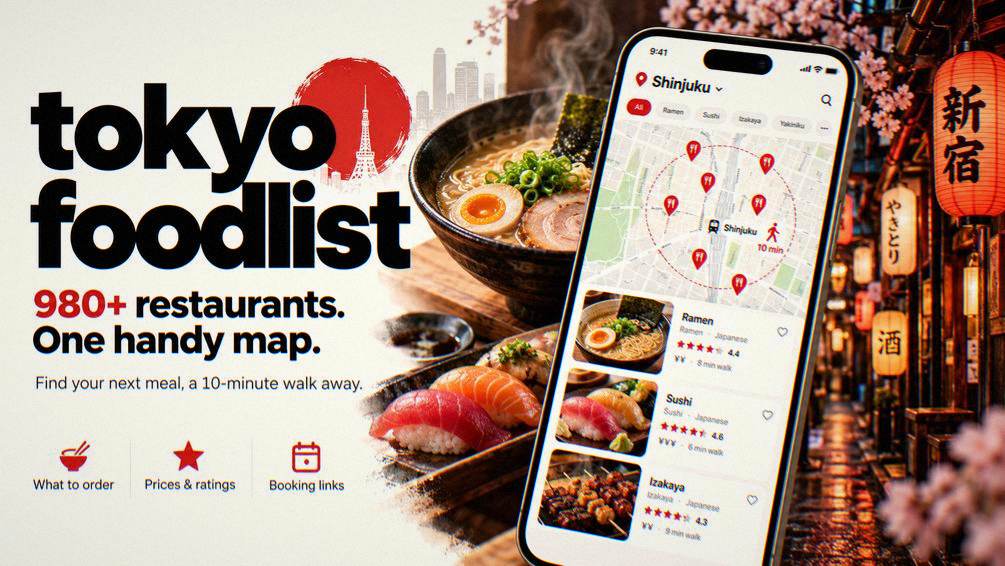
The curated 100 are themselves a subset of the 980+ restaurants in The Tokyo Food List, our own guide, which sorts by cuisine, Google rating and price range, flags reservation difficulty and booking links, and drops Google Maps pins so you can see what is within a 10-minute walk of wherever you are standing. For Shibuya specifically, the booking label is the field that matters most: it tells you whether to turn up hungry or to plan the counter two weeks out.
What Defines The Shibuya Restaurant Scene?
Shibuya's record set leans casual and inexpensive, but its highest-rated entries book out. Of the 13 records, five sit at the inexpensive price level and seven at moderate, with only Matsue Ebisu Head Store rated expensive, yet the four sushi records all carry booking labels and the ward's biggest review pool, Jikasei MENSHO at 4.8 across 4,480 reviews, is a queue-not-booking ramen counter. Shibuya rewards both impulses at once.
The cuisine spread tells the story: four sushi records, three ramen records, and one each of coffee, dessert, izakaya, tempura, tonkatsu and wagyu. That is a ward built around singular destinations rather than deep cuisine benches, and it changes how you should plan. In Shinjuku you might spend an evening hopping between similar izakaya, covered in our guide to Shinjuku's best restaurants, but in Shibuya the strong play is one anchor booking plus one or two walk-in stops around it.
The ward is also visibly changing. Shibuya PARCO is renovating around 20 sections of its retail floor in autumn 2026, following a larger renovation of about 80 sections the year before, as reported by Dellows News, and PARCO already houses Jikasei MENSHO inside its food floor, so the dining geography around the station keeps shifting with the construction. The Shibuya Mark City complex announced that SHIBUYA PANORAMA, the 25th-floor dining level of Shibuya Excel Hotel Tokyu, opens two new venues in late November: a French bistro and an eight-seat sushi kappo counter, with reservations open from late October, per the operator's announcement.
Which Shibuya Restaurants Can You Walk Into Tonight?
Six of the 13 records are usually walk-in: CAFE REISSUE, Age.3×Q HARAJUKU, Jikasei MENSHO, Afuri Shibuya Dōgenzaka, Hakata Tempura Takao and Tonkatsu Tsukiuma SHIBUYA. Three of the six sit at the inexpensive price level and three at moderate, and all six carry Google ratings of 4.2 or higher. None of them needs a plan beyond arriving outside the peak dinner rush.
The walk-in half of Shibuya is where the ward feels most like itself. Jikasei MENSHO, 4.8 on Google across 4,480 reviews, serves spicy miso ramen, vegan tantanmen and truffle ramen, and its own page places it inside PARCO. Afuri Shibuya Dōgenzaka, 4.8 across 3,278 reviews, is the yuzu ramen address, with shio ramen and char siew rice alongside; its listing on the restaurant's site confirms the Dōgenzaka branch. Both are queue places, usually walk-in, meaning no reservation mechanism stands between you and the bowl. To eat your way through the city area by area, The Tokyo Food List is made to open on a phone and pick by neighborhood.
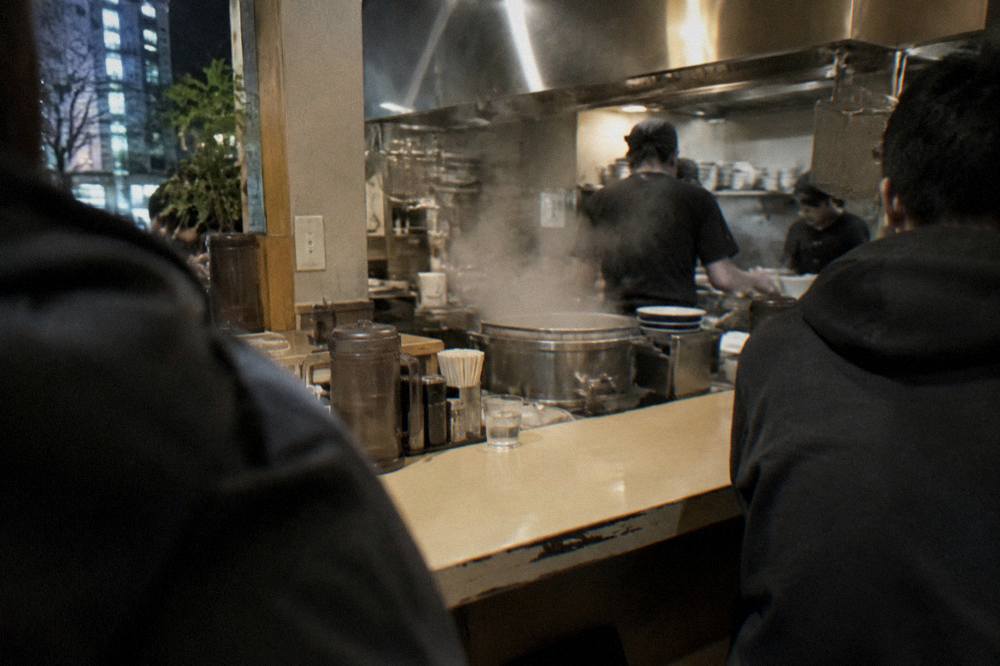
The walk-in set is not only ramen. Hakata Tempura Takao, 4.2 across 559 reviews and labelled moderate and usually walk-in, lists mentaiko, asazuke and kelp as its order tags, a small-plates tempura counter format rather than a full course. Tonkatsu Tsukiuma SHIBUYA, 4.4 across 652 reviews, is the ward's tonkatsu record with butajiru, katsudon and chicken egg on its order line, and it tends to draw a local crowd. CAFE REISSUE, 4.7 across 2,405 reviews, pours hot chocolate and cheesecake in a moderate price band, and Age.3×Q HARAJUKU, 4.9 across 2,650 reviews, sells creme brulee and fried fruit sandwiches at an inexpensive price level, one of the highest ratings in the entire curated 100.
| Restaurant | Cuisine | Google rating | Reviews | Price level | Booking label |
|---|---|---|---|---|---|
| Jikasei MENSHO | ramen | 4.8 | 4,480 | inexpensive | usually walk-in |
| Afuri Shibuya Dōgenzaka | ramen | 4.8 | 3,278 | inexpensive | usually walk-in |
| Age.3×Q HARAJUKU | dessert | 4.9 | 2,650 | inexpensive | usually walk-in |
| CAFE REISSUE | coffee | 4.7 | 2,405 | moderate | usually walk-in |
| Tonkatsu Tsukiuma SHIBUYA | tonkatsu | 4.4 | 652 | moderate | usually walk-in |
| Hakata Tempura Takao | tempura | 4.2 | 559 | moderate | usually walk-in |
Which Shibuya Counters Need A Booking?
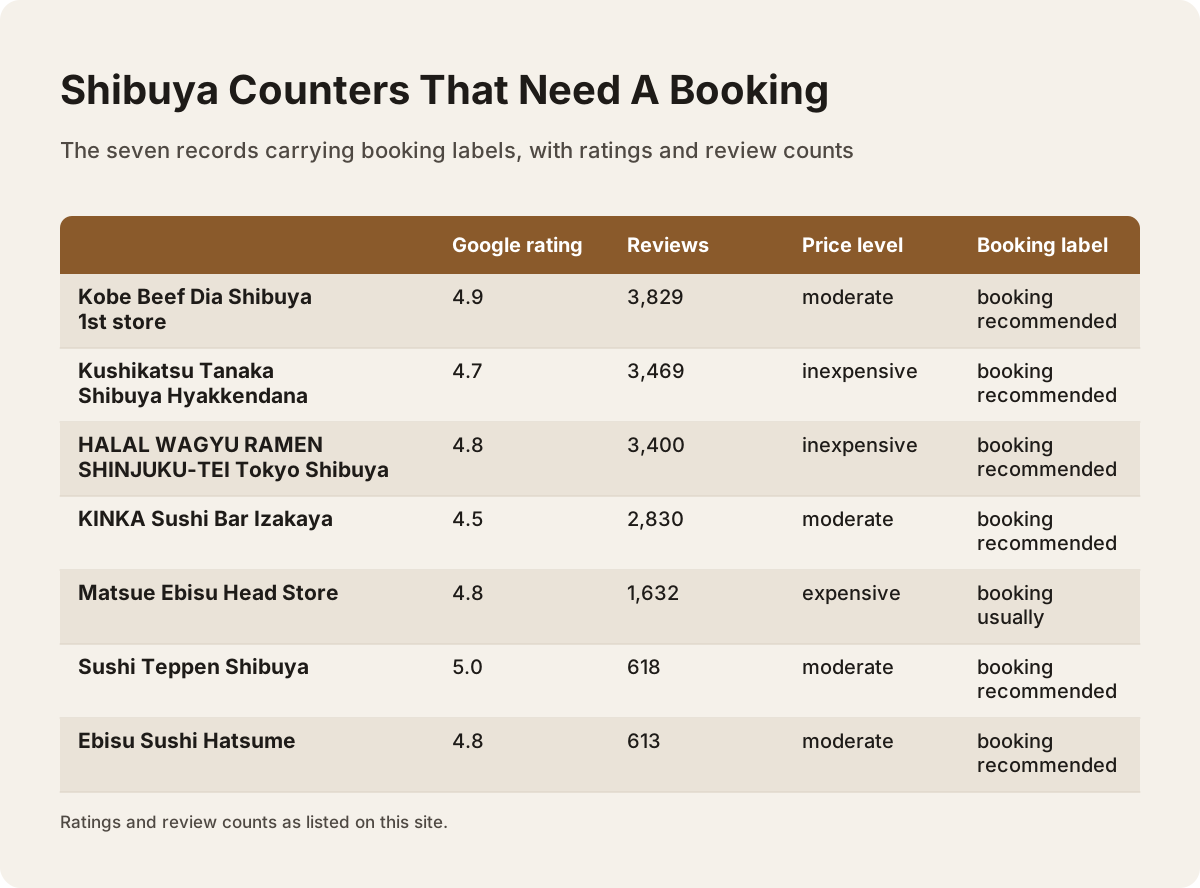
Seven records want a booking in some form: six carry the booking-recommended label and Matsue Ebisu Head Store is booking usually required. The booked set spans inexpensive izakaya through expensive sushi, and it includes the ward's two biggest non-ramen review pools, Kushikatsu Tanaka Shibuya Hyakkendana at 3,469 reviews and Kobe Beef Dia Shibuya 1st store at 3,829.
Booking labels describe what usually happens, not a fixed policy, so treat them as strong guidance rather than a guarantee. Kushikatsu Tanaka Shibuya Hyakkendana, 4.7 across 3,469 reviews, is inexpensive and booking recommended, serving gyukatsu and takoyaki; the chain's branch page carries the shop details. Kobe Beef Dia Shibuya 1st store, 4.9 across 3,829 reviews, is the ward's wagyu record, moderate in price and booking recommended, with kobe beef and teppanyaki as its order tags; its listing sits on the operator's own site. Both are the kind of evening anchor you lock first and build the night around.
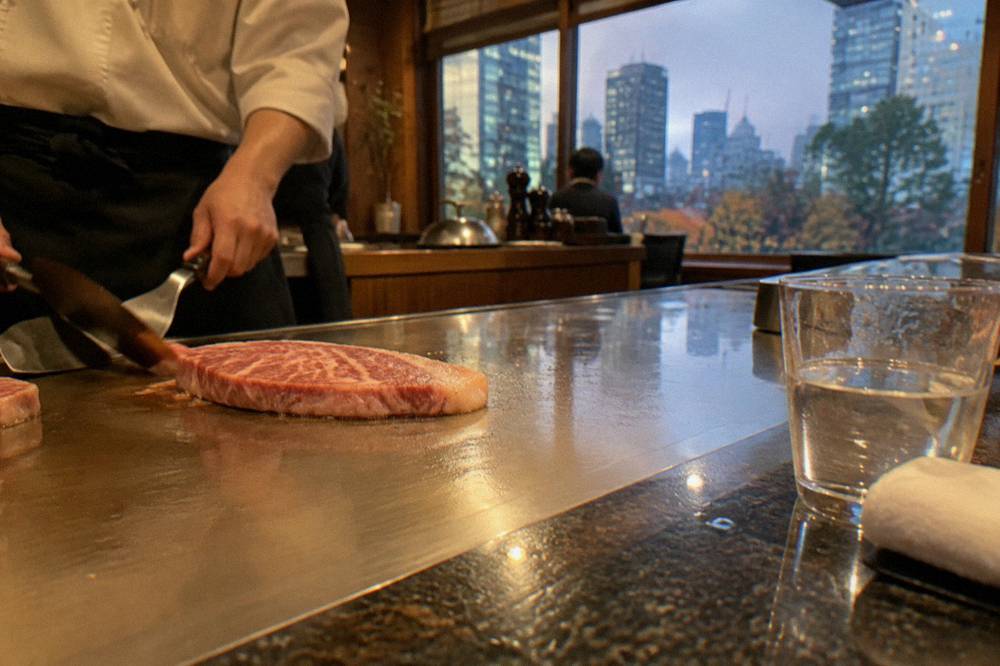
At the top of the planning scale sits Matsue Ebisu Head Store, 4.8 across 1,632 reviews, expensive and booking usually required, with omakase, sea urchin and toro on its order line; the restaurant's own page carries the details. High-end and omakase restaurants commonly charge 30 to 50 percent of the course price for cancellations a few days ahead, rising to 100 percent for same-day cancellations and no-shows, per SHOKU NOREN's cancellation-policy guide, so treat that booking as a commitment. If you want a fuller walk-through of reservation mechanics in Japan, our reservations explained article covers the platforms and the phone-only cases.
| Restaurant | Cuisine | Google rating | Reviews | Price level | Booking label |
|---|---|---|---|---|---|
| Kobe Beef Dia Shibuya 1st store | wagyu | 4.9 | 3,829 | moderate | booking recommended |
| Kushikatsu Tanaka Shibuya Hyakkendana | izakaya | 4.7 | 3,469 | inexpensive | booking recommended |
| HALAL WAGYU RAMEN SHINJUKU-TEI Tokyo Shibuya | ramen | 4.8 | 3,400 | inexpensive | booking recommended |
| KINKA Sushi Bar Izakaya | sushi | 4.5 | 2,830 | moderate | booking recommended |
| Matsue Ebisu Head Store | sushi | 4.8 | 1,632 | expensive | booking usually required |
| Sushi Teppen Shibuya | sushi | 5.0 | 618 | moderate | booking recommended |
| Ebisu Sushi Hatsume | sushi | 4.8 | 613 | moderate | booking recommended |
Sushi In Shibuya: How Do The Four Records Compare?
The four sushi records split cleanly by commitment and price: no inexpensive sushi records sit in Shibuya, so the ladder runs from KINKA Sushi Bar Izakaya, moderate and booking recommended at 4.5 across 2,830 reviews, up through Sushi Teppen Shibuya at 5.0 across 618 reviews, to Matsue Ebisu Head Store, expensive and booking usually required. None is usually walk-in.
KINKA Sushi Bar Izakaya, whose own site lists the Shibuya operation, is the social option: seared sushi, aburi sushi and karaage share the order line, and the izakaya suffix signals a longer, drink-led sitting rather than a pure counter meal. Sushi Teppen Shibuya is the rating outlier, a perfect 5.0 on Google across 618 reviews, moderate in price, booking recommended, and it tends to draw a local crowd; omakase, negitoro and sea urchin are its order tags, and its details sit on the restaurant's own page.
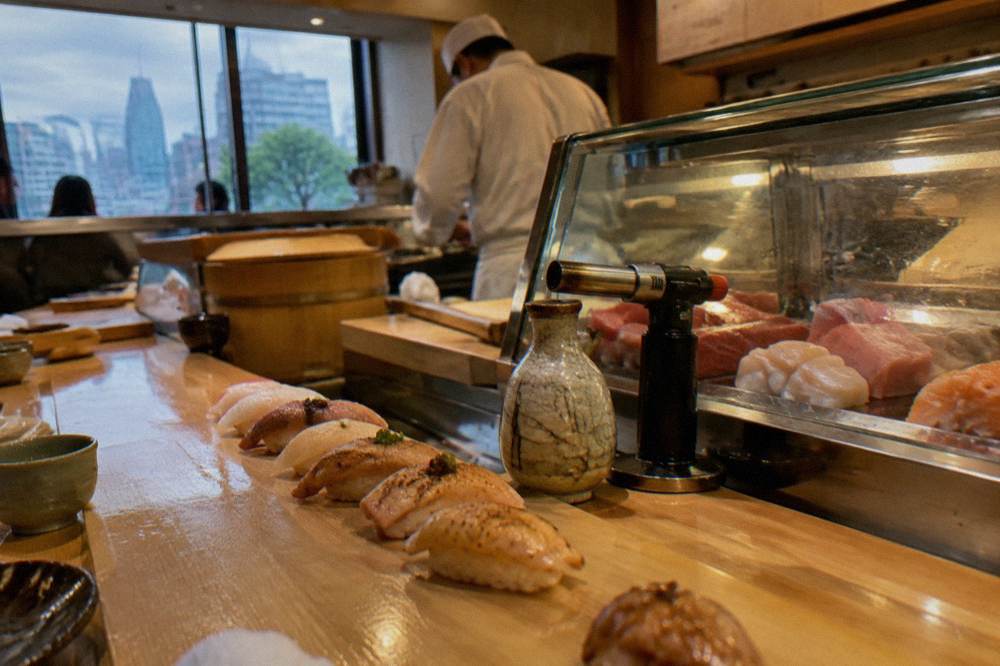
Ebisu Sushi Hatsume, 4.8 across 613 reviews and also local-leaning, lists omakase and a tuna-and-sea-urchin signature among its order tags, and rounds out a set in which all four records want a booking to some degree. For context on the wider sushi landscape, including the 16-record comparison across wards, see our Tokyo sushi guide. Within Shibuya itself the choice is really between a rollicking aburi-and-karaage night at KINKA and a quieter booked counter at Teppen or Hatsume, with Matsue Ebisu as the splurge that usually requires the firmest planning.
| Sushi record | Google rating | Reviews | Price level | Crowd label | Order tags |
|---|---|---|---|---|---|
| KINKA Sushi Bar Izakaya | 4.5 | 2,830 | moderate | mixed | seared sushi, aburi sushi, karaage |
| Matsue Ebisu Head Store | 4.8 | 1,632 | expensive | mixed | omakase, sea urchin, toro |
| Sushi Teppen Shibuya | 5.0 | 618 | moderate | local | omakase, negitoro, sea urchin |
| Ebisu Sushi Hatsume | 4.8 | 613 | moderate | local | omakase, tuna and sea urchin |
What Should You Order At Each Standout Shibuya Restaurant?
The order tags do the deciding for you: spicy miso ramen, vegan tantanmen or truffle ramen at Jikasei MENSHO, yuzu ramen at Afuri Shibuya Dōgenzaka, gyukatsu and takoyaki at Kushikatsu Tanaka, kobe beef and teppanyaki at Kobe Beef Dia, and creme brulee plus a fried sandwich at Age.3×Q HARAJUKU. Every tag below comes straight from the restaurant records, not from reviews.
Order tags answer the what-do-I-get question, and in Shibuya they are unusually decisive because several records have one unmistakable dish. Afuri's yuzu ramen is the reason the Dōgenzaka branch exists in most travellers' itineraries, and HALAL WAGYU RAMEN SHINJUKU-TEI Tokyo Shibuya, 4.8 across 3,400 reviews and labelled tourist-leaning, puts wagyu and chicken ramen on its order line; its own site carries the details, and halal here is what the listing says, worth confirming directly with the restaurant before you go. If the ramen decision feels bigger than one ward, our Tokyo ramen guide covers all 15 curated records.
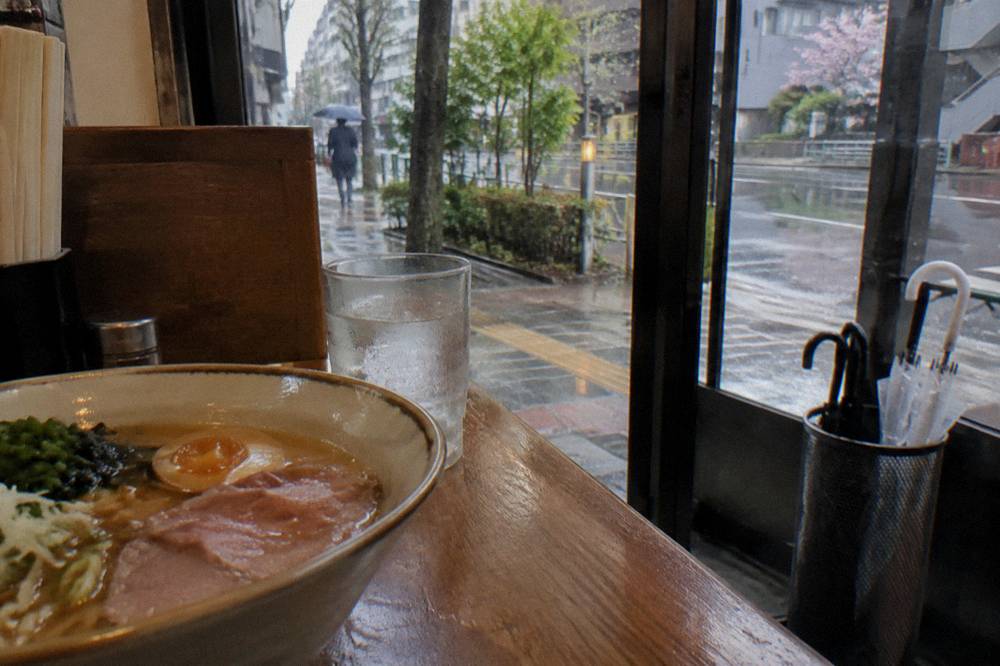
At the sweet end, Age.3×Q HARAJUKU's fried fruit sandwich is the dish that built its 4.9 rating across 2,650 reviews, and CAFE REISSUE pairs its cheesecake with a hot chocolate that anchors the moderate price band. Tonkatsu Tsukiuma's katsudon with butajiru is the ward's one-plate lunch answer, and Hakata Tempura Takao's mentaiko, asazuke and kelp order tags point to a lighter stop rather than a big main meal. The Tokyo Food List carries these order tags for all 980+ listings, with updates staying on the same link, which is the fastest way to resolve a what-to-order argument on the pavement outside.
| Restaurant | Order tags from the record | Booking implication |
|---|---|---|
| Jikasei MENSHO | spicy miso ramen, vegan tantanmen, truffle ramen | queue, usually walk-in |
| Afuri Shibuya Dōgenzaka | yuzu ramen, shio ramen, char siew rice | queue, usually walk-in |
| Age.3×Q HARAJUKU | creme brulee, sandwiches, fried sandwich | usually walk-in |
| Kushikatsu Tanaka Shibuya Hyakkendana | gyukatsu, takoyaki | booking recommended |
| Kobe Beef Dia Shibuya 1st store | kobe beef, teppanyaki | booking recommended |
| Matsue Ebisu Head Store | omakase, sea urchin, toro | booking usually required |
How Much Do Restaurants In Shibuya Cost By Price Level?
Five of the 13 Shibuya records are inexpensive and seven are moderate, leaving one expensive record, so most of the ward eats cheaply by design. The inexpensive set spans three ramen shops, one dessert counter and one izakaya, while the moderate set covers coffee, tempura, tonkatsu, three sushi records and the wagyu address. Price level here is a Food List band, not a yen figure.
That distribution mirrors the wider curated 100, where 43 records are inexpensive and 38 moderate against only 16 expensive and 3 very expensive, and it explains why Shibuya works so well as a mixed evening: you can anchor at an inexpensive ramen counter, follow with a moderate booked counter, and finish inexpensive again at the dessert shop without ever touching the expensive tier. The one expensive record, Matsue Ebisu Head Store, is also the only booking-usually-required record in the ward, which is a pattern worth noticing: price and booking difficulty climb together here.
Shibuya Counters That Need A Booking
Context matters when reading those bands. Dine-in restaurant meals in Tokyo carry 10% consumption tax while identical takeout is taxed at the reduced 8% rate, per NHK WORLD-JAPAN News, so the same gyudon or bento costs fractionally more eaten at a table. Tipping is not customary and staff may return money left behind, per japan-guide.com's Tokyo dining guidance, so the menu price is the whole price. If you are weighing whole-meal budgets rather than single dishes, our piece on what a Tokyo meal costs breaks it down further.
| Price level | Count in Shibuya | Records |
|---|---|---|
| inexpensive | 5 | Jikasei MENSHO, Afuri Shibuya Dōgenzaka, Age.3×Q HARAJUKU, Kushikatsu Tanaka Shibuya Hyakkendana, HALAL WAGYU RAMEN SHINJUKU-TEI Tokyo Shibuya |
| moderate | 7 | CAFE REISSUE, KINKA Sushi Bar Izakaya, Sushi Teppen Shibuya, Ebisu Sushi Hatsume, Hakata Tempura Takao, Tonkatsu Tsukiuma SHIBUYA, Kobe Beef Dia Shibuya 1st store |
| expensive | 1 | Matsue Ebisu Head Store |
Where Do Locals Eat In Shibuya Versus Tourists?
Four Shibuya records tend to draw a local crowd: Sushi Teppen Shibuya, Ebisu Sushi Hatsume, Hakata Tempura Takao and Tonkatsu Tsukiuma SHIBUYA. One record, HALAL WAGYU RAMEN SHINJUKU-TEI Tokyo Shibuya, is labelled tourist-leaning, and the remaining eight draw a mixed crowd. The local-labelled four sit mostly in the moderate price band.
Crowd labels mark a real divide in Shibuya; they describe what usually happens, not a fixed policy. The two local sushi counters, Teppen and Hatsume, are moderate, booking recommended and comparatively small at 618 and 613 reviews, while the mixed-crowd giants, Jikasei MENSHO at 4,480 reviews and Kushikatsu Tanaka at 3,469, are inexpensive volume operations. The tourist-labelled record, the halal wagyu ramen shop, is also the ward's most internationally practical address, since halal options in Tokyo otherwise need active hunting.
None of this is a quality signal. A local crowd at a 559-review tempura counter and a mixed crowd at a 4,480-review ramen shop are simply different evenings, and the honest read is that Shibuya's local favourites are quieter, smaller and harder to stumble into, which is exactly why the booking label and the crowd label belong side by side when you plan. For a ward-by-ward comparison of how the curated records spread, our what to eat in Tokyo overview places Shibuya against Ginza, Asakusa and Shinjuku. If that comparison tilts you toward Ginza's polished counters or Asakusa's old-Tokyo favourites, our Ginza and Asakusa restaurant guide picks out the specific places worth planning an evening around.
| Crowd label | Count | Records |
|---|---|---|
| local | 4 | Sushi Teppen Shibuya, Ebisu Sushi Hatsume, Hakata Tempura Takao, Tonkatsu Tsukiuma SHIBUYA |
| mixed | 8 | Jikasei MENSHO, Afuri Shibuya Dōgenzaka, CAFE REISSUE, Age.3×Q HARAJUKU, Kushikatsu Tanaka Shibuya Hyakkendana, KINKA Sushi Bar Izakaya, Matsue Ebisu Head Store, Kobe Beef Dia Shibuya 1st store |
| tourist | 1 | HALAL WAGYU RAMEN SHINJUKU-TEI Tokyo Shibuya |
Can You Learn To Make Shibuya-Style Ramen Yourself?
A 90-minute Shibuya cooking class covers tonkotsu, shoyu and miso ramen from scratch, from $113.36 per person, rated 5.0 across 259 reviews, with a maximum of 20 travellers, a meal included and free cancellation. It converts the ward's signature cuisine from something you queue for into something you can reproduce at home.
The class sits in the same cuisine family as the three ramen records above, which is what makes it a genuinely Shibuya-flavoured activity rather than a generic cooking lesson: tonkotsu, shoyu and miso are the three broth traditions that dominate the city's ramen scene, and our ramen guide explains how they differ. As an evening alternative when every counter near the crossing has a line, it also sidesteps the queue question entirely, and the free-cancellation terms mean a sudden invitation to a booked counter does not strand the spend. Check availability on the operator's live listing if that trade appeals.
One planning note: the meeting point details sit on the live listing rather than in our verified roster, so confirm the start location when you book. Pairing the class with a walk-in ramen evening elsewhere in the ward, say Afuri's yuzu bowl the following night, gives you both sides of the same cuisine in one trip.
What About Drinking And Bar Hopping Around Shibuya?
Shibuya's own records cover one izakaya, but the strongest guided drinking option runs from Shinjuku: a three-hour bar hop with a free-flow full dinner through the Golden Gai area, from $109.35 per person, rated 4.9 across 4,086 reviews, capped at 7 travellers, with drinks, a meal and free cancellation included.
That cap of seven matters. Golden Gai holds around 280 bars, many seating five or six people, per The Japan Pro's count of the district, so a small-group format is not a luxury there but a practical necessity, since a dozen travellers cannot fit into a five-seat counter. The tour's free-flow dinner format also neutralises the two charges that catch solo visitors in that district: many Golden Gai bars charge a seat or cover charge per person, often posted on the door, per Izakaya Manual's guide to the area. If you would rather stay in Shibuya, Kushikatsu Tanaka Shibuya Hyakkendana is the ward's booked izakaya record, and the standing bars around the station core fill the gap on a lighter budget. Check availability for the bar hop on the operator's listing if the maths of Golden Gai's tiny counters appeals.
Smoking rules shape these nights too: smoking is banned in the alleys of Golden Gai and Omoide Yokocho except inside shops that allow it, per tripguide.tokyo's district guide, and indoor smoking in Tokyo restaurants is prohibited by default under the Tokyo ordinance in force since April 2020, with signage at each entrance showing the status. Neither rule affects the food, but both affect where you linger after the last skewer.
How Should You Structure One Perfect Evening In Shibuya?
Pick one booked anchor and surround it with walk-in stops: lock Kobe Beef Dia or Kushikatsu Tanaka first, queue at Jikasei MENSHO or Afuri before it, and finish at Age.3×Q HARAJUKU. The booking-usually-required record, Matsue Ebisu, deserves its own evening rather than a slot in a crawl, because omakase counters run on their own clock.
The mechanics favour early booking. High-end counters typically release seats one to two months ahead, per travel writers covering Tokyo's starred restaurants, and cancellation penalties at omakase venues commonly reach 100 percent for same-day changes, per SHOKU NOREN. Within the curated 100 overall, 48 records are booking recommended and 7 booking usually required, so Shibuya's one usually-required record is rare even by city standards, and the six-restaurant walk-in pool here is generous compared with wards dominated by booked sushi. The Tokyo Food List exists precisely for this decision: it flags reservation difficulty and booking links for all 980+ listings and maps what is within a 10-minute walk, made to be opened on a phone while you decide on the pavement.
Timing quirks deserve a line. Many Tokyo restaurants close between lunch and dinner service and often close on Sundays, Mondays or national holidays, per japan-guide.com's venue listings, so a Monday evening plan should lean on the chain-backed records, and a late finish costs extra at some major chains, which apply a roughly 7% surcharge on orders from 10 p.m. onward, per a Kookmin Ilbo report on the practice. Build the crawl to end by ten and both problems vanish.
Common Questions About Shibuya Restaurants
Which restaurants in Shibuya do not need a reservation?
Six of the 13 curated records are usually walk-in: Jikasei MENSHO, Afuri Shibuya Dōgenzaka, Age.3×Q HARAJUKU, CAFE REISSUE, Tonkatsu Tsukiuma SHIBUYA and Hakata Tempura Takao. Crowd labels describe what usually happens, so arrive outside peak hours for the shortest wait.
What is the best-rated restaurant in Shibuya?
By Google rating, Sushi Teppen Shibuya holds a perfect 5.0 across 618 reviews, followed by Age.3×Q HARAJUKU and Kobe Beef Dia Shibuya 1st store at 4.9. By review volume, Jikasei MENSHO leads the ward with 4,480 reviews at 4.8.
How much do Shibuya restaurants cost?
Five of the 13 records are in the inexpensive price band and seven are moderate, with only Matsue Ebisu Head Store in the expensive band. These are Food List price bands rather than yen figures, and dine-in meals carry 10% consumption tax while takeout is taxed at 8%.
Where can I eat sushi in Shibuya?
Four curated sushi records sit in Shibuya ward: KINKA Sushi Bar Izakaya, Matsue Ebisu Head Store, Sushi Teppen Shibuya and Ebisu Sushi Hatsume. All four carry booking labels, so reserve ahead rather than walking in.
Is halal food available in Shibuya?
HALAL WAGYU RAMEN SHINJUKU-TEI Tokyo Shibuya, 4.8 across 3,400 reviews, carries halal in its name and lists wagyu and chicken ramen as order tags. Confirm directly with the restaurant before visiting, as listing names indicate the offer rather than certify it.
When should I book Shibuya restaurants?
For the booking-recommended records, book as soon as your dates are fixed, and treat Matsue Ebisu Head Store as needing the firmest plan since it is booking usually required. High-end counters across Tokyo typically open reservations one to two months ahead, and same-day cancellations at omakase venues commonly incur the full course price.