How Do I Make Reservations In Japan?
How Tabelog, OMAKASE, TableCheck, hotel concierges and phone calls each work for booking Tokyo restaurants, plus the walk-in alternative for places that need no reservation.
How Do I Make Reservations In Japan?
You make a restaurant reservation in Japan through one of four routes: an online booking platform such as Tabelog's multilingual service, OMAKASE or TableCheck; your hotel concierge; a phone call, usually needing a Japanese speaker; or, at the 45 of the 100 curated records on this site labelled usually walk-in, no reservation at all. The right route depends on the price level and the booking label of the place you want.
That answer sounds simpler than the reality, because the routes differ in cost, timing and failure modes. A platform booking is self-service and instant but carries a per-seat fee and a card registration. A concierge request costs nothing extra but depends on your hotel's relationship with the restaurant. A phone call is still the only channel some counters accept, and English is rarely spoken on that line. Walking in costs nothing but a queue, and at many mid-priced Tokyo restaurants it is genuinely the normal way to eat. Before you set your heart on a counter seat, The Tokyo Food List flags reservation difficulty and links straight to booking.
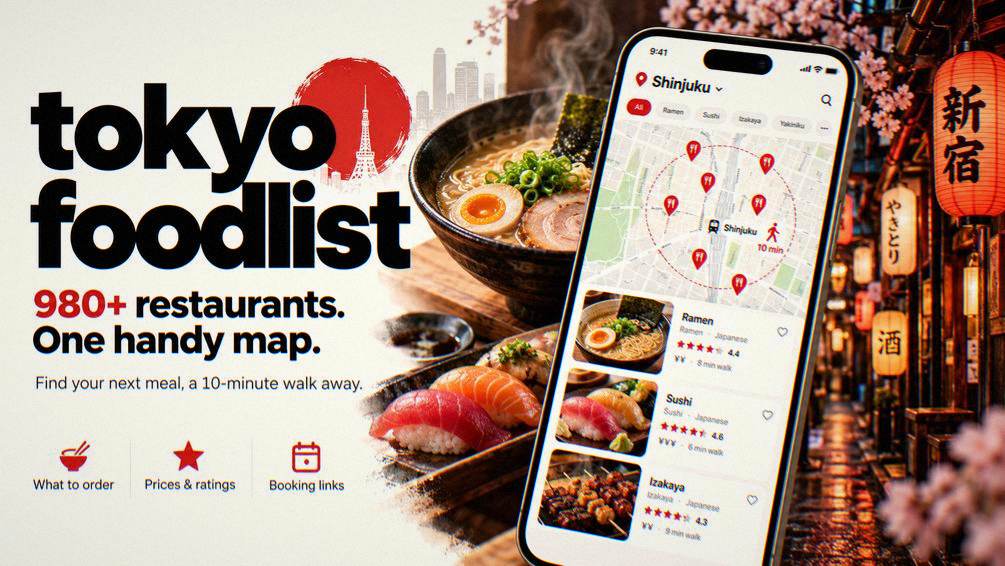
If you are still deciding where to book, our own guide, The Tokyo Food List, covers 980+ Tokyo restaurants with reservation difficulty labels and booking links for each one, so you can see at a glance which places need a platform, which need a concierge and which simply take walk-ins. It sorts by cuisine, Google rating and price range, and it is made to open on a phone and pick by neighbourhood. If wagyu is what you're chasing, our wagyu and teppanyaki in Tokyo guide explains what the grades actually mean and how to pick between a steakhouse and a yakiniku counter.
Which Booking Platforms Work For Tokyo Restaurants?
Three English-friendly platforms do most of the work: Tabelog's multilingual booking (about 440 yen per person, card required), OMAKASE (about 390 yen per seat, card registration required) and TableCheck, which often needs a card for a hold or prepayment. Many top counters still require a Japanese phone number or a Japanese speaker on the phone, which is where a hotel concierge comes in.
These figures come from the NativeCall guide to English-friendly booking platforms, which notes that the fees sit separately from the meal price and are generally not refunded if you cancel for your own reasons. The mechanics matter more than the numbers. OMAKASE specialises in high-end counters: you register with an SMS-capable mobile number and a credit card, the interface runs in English, and the culture stays strictly Japanese, with timed seat releases and stiff cancellation terms. Popular omakase counters typically open reservations about two months ahead, and availability disappears quickly, with cherry blossom and autumn foliage seasons compressing timelines further.
TableCheck is the lighter option. Many mid-range restaurants use it for plain online bookings, sometimes with a card hold rather than prepayment. Some venues switch systems entirely: the sushi restaurant Sushi Tokinari moved from TableCheck to OMAKASE and changed from a card hold to full course prepayment at reservation, a shift high-end diners are seeing more often.
| Route | Typical cost | Card needed | Best for | Weakness |
|---|---|---|---|---|
| Tabelog multilingual booking | About 440 yen per person | Yes | Mid-range and popular spots | Fee not refunded on self-cancellation |
| OMAKASE | About 390 yen per seat | Yes, at registration | High-end counters | Timed releases, strict cancellation terms |
| TableCheck | Usually no fee | Often, for hold or prepayment | Mid-range bookings | Coverage limited to venues using it |
| Hotel concierge | Included in the stay | No | Phone-only and starred counters | Depends on hotel relationships |
| Phone call | Free | No | Counters that accept no other channel | Usually needs a Japanese speaker |
Among the curated records on this site, the booking labels split unevenly by cuisine, and that split should drive your route. Of the 16 sushi records, 4 are usually walk-in, 8 are booking recommended and 4 are booking usually required. All 8 yakitori records recommend booking. Ramen is the outlier in the other direction: 10 of 15 ramen records are usually walk-in, which matches the ticket-machine, fast-turnover reality of the format. Our own guide, The Tokyo Food List, carries these same booking labels across all 980+ listings, so the check takes seconds rather than a search session. If the sushi end of that split feels daunting, our Sushi Jiro reservation guide explains how bookings at Sukiyabashi Jiro work and which other Tokyo counters are easier to lock in.
How Far Ahead Should You Book A Tokyo Restaurant?
For Michelin-starred counters, book one to two months ahead, typically via an online service, a concierge or the Michelin partner OMAKASE. Popular mid-range places usually need days to a couple of weeks. Walk-in labelled restaurants need no booking at all, only a tolerance for queueing at peak hours. High-end cancellation policies bite hardest the closer you get to the date.
The one-to-two-month window is the standard cadence for sought-after counters, and the reason is mechanical: seats at many of them open on a set schedule, and platforms release them in rounds. Some omakase venues release seats in staggered rounds with limits such as one booking per account every two months, and lunch slots may appear later even if absent on the initial release day. If a restaurant shows nothing on the platform, checking again a day later is part of the process, not a failure.
The curated records show what booking usually required looks like in practice. Matsue Ebisu Head Store, 4.8 on Google across 1,632 reviews and expensive, takes omakase bookings at its Shibuya counter. Sushi Yuu in Azabu, 4.8 across 504 reviews, expensive, with omakase and fatty tuna on the order tags, is the same story with a local crowd. Sushi Kuni in Tsukiji, 4.3 across 1,463 reviews, is a booking usually required record where the order tags run to unidon and salmon roe bowls. Tempura reaches the same tier at Mikawa Zezankyo in Koto, very expensive and booking usually required, with kuruma prawn and shiso sea urchin among the order tags. If you'd rather chase a table with some history behind it, Anthony Bourdain's on-camera Tokyo picks and how to book them now covers the spots he actually ate at and what reservations look like today.
| Restaurant | Cuisine and area | Google rating | Price level | Booking label |
|---|---|---|---|---|
| Matsue Ebisu Head Store | Sushi, Shibuya | 4.8 across 1,632 | Expensive | Booking usually required |
| Sushi Yuu | Sushi, Minato | 4.8 across 504 | Expensive | Booking usually required |
| Sushi Kuni | Sushi, Chuo | 4.3 across 1,463 | Expensive | Booking usually required |
| Mikawa Zezankyo | Tempura, Koto | 4.3 across 653 | Very expensive | Booking usually required |
| Tonkatsu Narikura | Tonkatsu, Suginami | 4.2 across 609 | Very expensive | Booking usually required |
| Shabu Shabu & Sushi Hassan Roppongi | Sushi, Minato | 4.5 across 676 | Expensive | Booking usually required |
Booking usually required does not mean impossible. It means the seat is sold weeks ahead, through one of the routes above, and that arriving without one is a coin toss at best. If the counters you want are closed to you on this trip, a booked food experience can cover the same ground: the Omakase Sushi and A5 Wagyu tour combines a premium tasting itinerary with a seated meal in one 3-hour slot, from $130.73 per person, with a maximum of 8 travellers, drinks included and free cancellation, rated 4.7 across 329 reviews. Check availability
Can A Hotel Concierge Or A Phone Call Get You In?
Yes, and for some restaurants they are the only routes. Many top places still need a Japanese phone number or a Japanese speaker for phone-only booking, which is exactly what a hotel concierge provides. Phone bookings cost nothing, but you should give the concierge the restaurant name, date, party size and a time window, and expect the answer to take hours rather than minutes.
The concierge route is strongest where platforms are weakest. A counter that takes no online bookings, or one whose platform releases vanish in minutes, will often hold seats for a hotel's request. The Michelin Guide's own booking partner for Tokyo is OMAKASE, and TableCheck maintains a partnership enabling direct online reservations for participating listed restaurants, so a starred kitchen's website will usually point you to one of those two or to a phone line. Some venues use prepayment guarantees to reduce no-show risk and increase acceptance of international guests, which is another way of saying that the prepaid route is often the friendlier one for foreign visitors.
Phone etiquette on the Japanese side is brief: name, date, headcount, time. If you are calling yourself and your Japanese is limited, calling at opening time, just after lunch service starts, tends to reach staff at their calmest. Some high-end wagyu venues have gone the other way and closed their phone lines entirely, taking online bookings only, with weekend slots filling first, so check the restaurant's own page before assuming a call will work.
For more on the timing question, the guide to Tokyo restaurants that require reservations breaks the booking labels down by cuisine, and the walkthrough of typical sushi dinner prices in Tokyo helps you decide whether a hard-to-book counter is worth the effort at your budget.
What Happens If You Cancel Or No-Show?
High-end and omakase restaurants commonly charge 30 to 50 percent of the course price for cancellations a few days ahead, rising to 100 percent for same-day cancellations and no-shows, with the fee charged to your registered card. Platform booking fees, such as OMAKASE's per-seat charge, are generally not refunded on self-cancellation. Read the policy before you book, not after.
The detail that catches visitors is the clock. Cancellation policies on booking platforms are calculated from Japan Standard Time midnight, regardless of when you confirmed, and they apply even on the confirmation day itself if you are inside the penalty window. A cancellation that feels like six days out from your time zone can land inside the penalty window from the restaurant's. If your plans are soft, free-cancellation experiences and walk-in restaurants are the safer building blocks of an itinerary.
This is also where the otoshi appetizer and table charge world of izakaya meets the booking world: the small automatic appetizer works as a per-person table charge at most izakaya, typically a few hundred yen, and it is tied to the seat in much the same spirit. Seats are the scarce resource, and the whole reservation culture protects them. The deeper rules are laid out in the site's Tokyo izakaya and yakitori guide.
Which Tokyo Restaurants Can You Walk Into Without Booking?
Forty-five of the 100 curated records on this site are labelled usually walk-in, concentrated in ramen, udon, coffee and counter sushi. Ten of the 15 ramen records and 4 of the 16 sushi records need no booking. Walking in costs a queue at peak times rather than a fee, and the fast turnover at counter shops means the queue moves quickly.
The walk-in tier is not the bargain basement, either. Sushi Mon Shinjuku is 4.7 on Google across 1,552 reviews and inexpensive, labelled usually walk-in. Uogashi Nihon-Ichi, 4.5 across 2,629 reviews and moderate, is a standing sushi chain record with the same label. R/Q, 4.9 across 680 reviews, is a usually walk-in sushi record at a moderate price level. At the booking-recommended-but-not-required tier, Shinjuku Sushi Hatsume, 4.9 across 2,487 reviews, and its Ebisu sibling, 4.8 across 613 reviews, both take omakase orders and sit at moderate prices, which makes them realistic same-week targets rather than month-ahead projects.
| Restaurant | Cuisine | Google rating | Price level | Booking label |
|---|---|---|---|---|
| Sushi Mon Shinjuku | Sushi | 4.7 across 1,552 | Inexpensive | Usually walk-in |
| Uogashi Nihon-Ichi | Sushi | 4.5 across 2,629 | Moderate | Usually walk-in |
| R/Q | Sushi | 4.9 across 680 | Moderate | Usually walk-in |
| Shinjuku Sushi Hatsume | Sushi | 4.9 across 2,487 | Moderate | Booking recommended |
| Ebisu Sushi Hatsume | Sushi | 4.8 across 613 | Moderate | Booking recommended |
The walk-in habit has one prerequisite: knowing which door to walk through. That is the other job our own guide does, with a map of what is within a 10-minute walk of wherever you are standing, sorted by price band and booking difficulty, and updates stay on the same link.
If you would rather learn the formats than hunt individual counters, a class turns the booking problem off entirely. The Asakusa sushi making class with matcha and unlimited sake runs 90 minutes from $44.93 per person, rated 4.94 across 206 reviews, with a meal and drinks included and free cancellation. It is a booked seat by definition, so nothing about the evening depends on a concierge or a phone line.
Between the platforms, the concierge desk, the phone and the plain walk-in queue, every restaurant on Best Restaurants Tokyo is reachable through at least one route. Match the route to the booking label, book the usually required counters a month or two out, and leave the walk-in tier for the evenings your plans fall apart.
For planning around the whole meal economy, the site's pieces on cash versus card in Japan and omakase dining in Tokyo fill in the payment and format questions a reservation raises.
Common Questions About Making Reservations In Japan
How Do I Make Reservations In Japan?
Use an online platform such as Tabelog's multilingual booking, OMAKASE or TableCheck; ask your hotel concierge; phone with a Japanese speaker; or walk in at one of the 45 of 100 curated records labelled usually walk-in. Starred counters typically need one to two months of lead time.
Do I need a credit card to book a Tokyo restaurant?
Often, yes. OMAKASE requires card registration at signup, Tabelog's multilingual booking takes a card, and TableCheck venues often need a card for a hold or prepayment. Phone and concierge bookings usually need no card, though high-end counters may prepay the course.
How far ahead should I book an omakase counter?
Typically one to two months, because seats at sought-after counters open on a set schedule and disappear quickly. Cherry blossom and autumn foliage seasons compress the timelines further, and some venues release seats in staggered rounds with booking frequency limits per account.
What happens if I cancel a restaurant booking in Japan?
High-end and omakase restaurants commonly charge 30 to 50 percent of the course price for cancellations a few days ahead, rising to 100 percent for same-day cancellations and no-shows. Platform per-seat booking fees are generally not refunded when you cancel for your own reasons.
Can I eat well in Tokyo without any reservations?
Yes. Forty-five of the 100 curated records on this site are labelled usually walk-in, including 10 of 15 ramen records and several counter sushi spots rated 4.5 or higher on Google with thousands of reviews. Expect to queue at peak hours, and remember many small ramen counters take cash or IC card only.